Sport-Specific Training for Adults: Peak Performance Guide
You don’t have to be a professional athlete to train like one — and sport-specific fitness might be exactly what your workout routine has been missing.
Here’s a scenario a lot of active adults know well: you’ve been working out consistently for months — lifting, doing cardio, staying active — but when you step back onto the basketball court, tennis court, or soccer field with friends, your body just doesn’t respond the way you expected. You’re out of breath faster than you’d like, your lateral movement feels sluggish, or your throws lack the punch they used to have.
This is the gap that sport-specific training was designed to close. It’s not just for elite athletes or weekend warriors chasing trophies. It’s for any adult who wants their fitness to translate into real-world performance — whether that means playing recreational tennis without tweaking your knee, keeping up with your kids in the backyard, or finally getting serious about your weekend league.
In this guide, you’ll learn exactly what sport-specific training is, how it works from a science perspective, how to build a program tailored to your chosen sport, and what most people get wrong when they try to do it on their own. By the end, you’ll have a clear, evidence-backed framework to train smarter — not just harder.
Why Sport-Specific Training Matters More Than You Think
Most general fitness programs are built around broad goals: lose fat, build muscle, improve cardiovascular health. These are all valuable, but they don’t account for the specific demands your sport places on your neuromuscular system, energy pathways, and movement mechanics.
Consider this: a competitive cyclist has exceptional aerobic capacity but may struggle with hip mobility and upper-body power needed in a sport like rowing or swimming. A powerlifter might deadlift 400 pounds but lack the rotational speed and reactive agility that tennis demands. Fitness is never fully transferable — at least, not without intentional design.
According to the American College of Sports Medicine (ACSM), training specificity is one of the foundational principles of exercise science. The SAID principle — Specific Adaptation to Imposed Demands — explains that your body adapts precisely to the type of stress placed on it. Train for endurance, you get endurance adaptations. Train for explosive power in lateral planes, you develop that specific capacity.
For adults aged 25 to 60 who are juggling careers, families, and finite recovery windows, this matters enormously. You don’t have unlimited time to train. Sport-specific programming ensures that the hours you put in actually translate to the field, court, or trail — not just to better gym numbers.
Research published in the Journal of Strength and Conditioning Research consistently shows that sport-specific training improves performance metrics like reaction time, sport movement efficiency, and injury resilience significantly more than general conditioning alone — especially in recreational adult athletes.
The Science Behind Sport-Specific Training: How It Actually Works
Sport-specific training is built on three intersecting pillars: energy system training, movement pattern development, and neuromuscular specificity. Understanding these helps you make smarter decisions about your program.
Energy system training means matching your conditioning work to how your sport actually fuels performance. Sports like soccer, basketball, and tennis are primarily anaerobic-dominant with aerobic recovery periods — meaning you need short, explosive bursts with the ability to recover quickly between points or plays. A long, slow 45-minute jog doesn’t replicate that demand. Sprint intervals, on the other hand, do.
Endurance sports like distance running, cycling, or rowing rely predominantly on oxidative (aerobic) pathways and demand sustained output — a completely different training emphasis.
Movement pattern development means training the exact planes of motion your sport uses. Baseball requires explosive hip rotation and shoulder stability. Basketball demands vertical jump mechanics and rapid direction changes. Swimming requires shoulder mobility and breath control. A generic squat-and-bench program won’t build those patterns efficiently.
Neuromuscular specificity is where things get fascinating. Your brain and nervous system need to be trained alongside your muscles. Reaction time, coordination, and sport-specific motor patterns are developed through deliberate repetition of sport-relevant movements. Research from the NIH’s National Institute of Neurological Disorders and Stroke confirms that motor learning is deeply pattern-specific — meaning your nervous system gets better at exactly what you practice, not at general movement.
One common myth worth busting here: many adults believe that simply getting in better shape will automatically improve their sport performance. While baseline fitness helps, it’s not a substitute for specificity. A general fitness level gets you on the field — sport-specific training keeps you performing there.
How to Get Started: Building Your Sport-Specific Program
Getting into sport-specific training doesn’t require a professional coaching staff. What it does require is an honest assessment of your sport’s demands and your current fitness gaps.
Step 1 — Analyze Your Sport’s Demands
Before programming a single workout, break your sport down into its core physical requirements. Ask: What energy systems does it use? What movement patterns repeat most often? What muscles or joints are most loaded? What does fatigue look like in this sport?
For example, if you play recreational soccer, your sport demands: aerobic base for 60-90 minutes of activity, repeated sprint capacity, lateral agility, and lower-body power for kicking and jumping. That becomes your training blueprint.
Step 2 — Assess Your Fitness Gaps
Run a simple self-assessment. Can you sprint at near-maximum effort and recover in under 60 seconds? Can you change direction quickly without feeling unstable? Do you fatigue long before your sport demands it? Identifying your weakest link tells you where to invest first.
Step 3 — Structure Your Training Week (Beginner)
- 2 days of sport-specific strength training (focus on movement patterns, not just muscle groups)
- 1-2 days of energy system work matched to your sport’s demands
- 1 day of sport practice or recreational play
- At least 1-2 full rest or active recovery days
Step 4 — Progress Intentionally (Intermediate to Advanced)
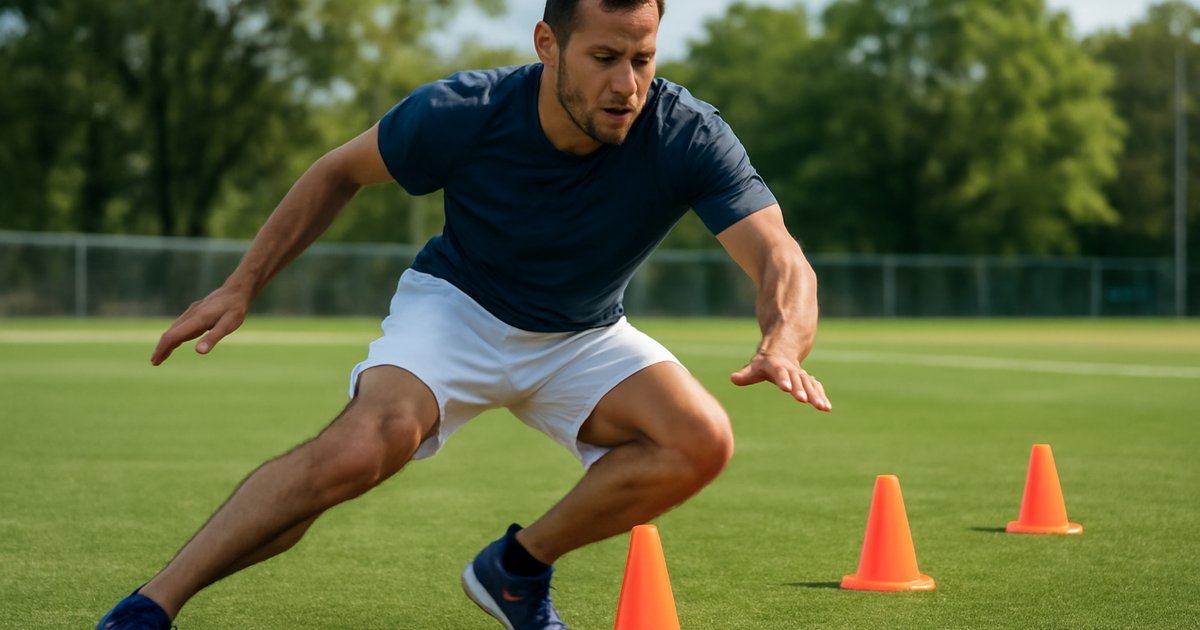
- Add reactive drills: cone work, ladder drills, partner reaction exercises
- Introduce periodization: build volume for 3 weeks, then reduce load in week 4 to allow adaptation
- Add sport-simulation conditioning: intervals that match the work-to-rest ratios of your sport
- Track both performance metrics (speed, agility time) and recovery quality
This works best when you’re playing your sport at least once per week — training in isolation without sport practice limits how well the adaptations transfer.
Common Mistakes That Sabotage Sport-Specific Results
Even motivated adults with solid fitness backgrounds make these errors when transitioning to sport-specific training. They’re easy to fall into — but just as easy to correct once you know what to look for.
Mistake 1 — Training movements that don’t match your sport’s planes of motion.
Most gym programs emphasize sagittal plane movements — squats, deadlifts, bench press, rows. These are valuable, but many sports occur heavily in the frontal and transverse planes (lateral movement, rotation). Tennis players who only squat and bench without adding rotational core work and lateral bounds are leaving a major performance gap open. Fix it by auditing your weekly training: are you working all three planes of motion relevant to your sport?
Mistake 2 — Ignoring energy system specificity and defaulting to generic cardio.
A 30-minute steady jog might feel like solid conditioning, but if your sport is tennis or basketball — where you’re making explosive efforts every 5 to 20 seconds with brief recovery — that training doesn’t translate. The Mayo Clinic notes that the body’s energy systems are highly specific, and endurance conditioning and power conditioning require distinctly different training stimuli. Match your cardio format to your sport’s actual energy demands.
Mistake 3 — Skipping prehabilitation and movement quality work.
Adults over 35 especially tend to skip warm-ups, mobility work, and joint-specific prehab exercises, reasoning that they’re there to train, not stretch. But sport-specific training places targeted stress on specific joints — the throwing shoulder, the planted knee, the lead hip in a golf swing. According to Harvard Health Publishing, musculoskeletal injuries in recreational adult athletes are most commonly linked to inadequate preparation and overuse without recovery. Build 10 to 15 minutes of movement preparation into every session — it’s part of the training, not an add-on.
Mistake 4 — Ramping up too fast, too soon.
Enthusiasm is great, but adult bodies — especially those returning to sport after a break — need a gradual ramp. The ACSM recommends increasing training volume by no more than 10% per week to manage injury risk. Going from no sport-specific training to five hard sessions a week is a recipe for overuse injury, not progress.
What to Eat to Support Sport-Specific Training
Nutrition for sport-specific training isn’t drastically different from general healthy eating — but the timing and emphasis shift depending on your sport’s energy demands.
Carbohydrates remain your primary fuel for most sports. According to the Academy of Nutrition and Dietetics, active adults engaged in moderate-to-high intensity training should consume 3 to 5 grams of carbohydrate per kilogram of body weight daily — more for endurance athletes, slightly less for lower-intensity or technical sports. Don’t undercut carbs in an attempt to lose weight while simultaneously training for sport performance; it will compromise your output and recovery.
Protein is non-negotiable for repair and adaptation. Research published in JAMA Internal Medicine supports a target of 1.2 to 1.7 grams of protein per kilogram of body weight for active adults engaged in regular sport training. Distribute this across meals — aim for 25 to 40 grams per meal from quality sources like eggs, chicken, Greek yogurt, fish, legumes, and cottage cheese.
Pre-training nutrition should prioritize easily digestible carbohydrates 60 to 90 minutes before a session — a banana with peanut butter, oatmeal with berries, or a rice cake with hummus are solid choices that fuel performance without gastrointestinal distress.
Post-training recovery nutrition matters for adaptation. A 3:1 or 4:1 ratio of carbohydrates to protein within 30 to 45 minutes after intense training supports glycogen replenishment and muscle repair. Chocolate milk, a protein smoothie with fruit, or Greek yogurt with granola all hit that target practically.
Hydration is frequently underestimated. The USDA Dietary Guidelines and the American College of Sports Medicine both recommend beginning exercise already well-hydrated, consuming 16 to 24 oz of water for every pound lost during activity, and avoiding relying on thirst alone as a hydration cue during intense training.
How Long Until You See Results — and What to Track
Sport-specific training results follow a predictable but non-linear curve. Here’s a realistic breakdown based on research and clinical exercise science guidelines.
Weeks 1 to 3 — Neural Adaptation Phase: You’ll feel more coordinated and movement patterns will begin to feel more natural. Performance improvements at this stage are largely neurological, not yet structural. Don’t be discouraged if you don’t feel physically stronger yet.
Weeks 4 to 8 — Early Structural Adaptation: Muscle recruitment patterns improve, anaerobic capacity begins to increase if you’re training it correctly, and sport-specific strength gains become more noticeable. This is when most people start saying “I feel better on the court.”
Weeks 8 to 16 — Performance Transfer: Measurable improvements in sport-relevant metrics — sprint time, agility test results, endurance through a full game, reduced recovery time between efforts. This is the phase where sport-specific training clearly outperforms general fitness training for performance goals.
Metrics worth tracking:
- A simple agility test time (e.g., a T-drill or 5-10-5 shuttle)
- Perceived exertion during sport play on a scale of 1-10
- Recovery time between hard efforts during play
- Injury frequency and joint discomfort levels
- Performance-specific skills (serve speed, shot accuracy, sprint distance per game)
Results vary significantly based on your starting fitness level, how consistently you train, how well you sleep and eat, and how much actual sport practice you incorporate. If you’ve been training consistently for 12 weeks and see no improvement in sport performance, consider consulting a certified strength and conditioning specialist (CSCS) for a program assessment.
If you’re new to structured training or want to complement your sport-specific work with solid foundational fitness, our guides on Circuit Training for Adults: Burn Fat and Build Strength and Agility Training for Adults: Move Faster, Think Sharper are excellent companions to this approach.
Frequently Asked Questions
Can I do sport-specific training if I’m over 50?
Absolutely — and it may be especially beneficial for older adults. Research from the National Institutes of Health shows that older adults who engage in activity-relevant training maintain functional capacity, balance, and joint health more effectively than those doing general gym work alone. The key adjustments are longer warm-ups, more recovery time between sessions, and a stronger emphasis on joint prehabilitation work. This isn’t a young person’s method — it’s a smart person’s method at any age.
Do I need to play my sport at a competitive level for this type of training to be worth it?
Not at all. Even if you play tennis twice a week recreationally, swim for enjoyment, or shoot hoops with friends on weekends, sport-specific training will help you enjoy those activities more, perform better, and significantly reduce your injury risk. The training scales to your goals — you don’t need competitive ambitions to benefit.
How is sport-specific training different from general strength training?
General strength training builds a fitness foundation — it improves overall muscle strength, bone density, and metabolic health. Sport-specific training takes that foundation and channels it into the exact movement patterns, energy systems, and physical qualities your sport demands. Ideally, you want both: a solid general base with a sport-specific layer built on top of it. For a great starting point on the general strength side, check out our guide on Barbell Training for Adults: Strength, Power & Longevity.
How many days a week should I train sport-specifically?
For most recreational adults, 2 to 4 days of structured sport-specific training per week is appropriate, depending on your overall fitness level, sport frequency, and recovery capacity. More is not always better — underprogrammed recovery is one of the leading causes of overuse injury in adult recreational athletes.
What if I play multiple sports seasonally?
Seasonal periodization is actually the ideal model. During your off-season for one sport, build your general fitness base. As your season approaches, shift toward sport-specific conditioning for 6 to 8 weeks pre-season. During the active season, maintenance training keeps your performance sharp without piling on excess fatigue. This approach mirrors how professional athletes structure their year — and it works just as well for recreational athletes.
Start Where You Are — Your Sport Deserves Your Best Effort
Sport-specific training isn’t an elite secret or a complicated protocol reserved for professional athletes. It’s a smarter way to connect the fitness you build in the gym to the activities you actually love doing — whether that’s Saturday morning tennis, a summer hiking league, recreational basketball, or competitive masters swimming.
The key is starting with intention. Understand what your sport demands. Identify your gaps. Build your program around those specific needs. And be consistent — the adults who see the most meaningful improvement in sport performance aren’t the ones who train the hardest, they’re the ones who train the most specifically and the most consistently over time.
Pick one small action today: write down your sport’s three biggest physical demands, and ask yourself honestly whether your current training addresses them. That clarity alone puts you ahead of most recreational athletes.
Your sport will reward the investment.
Wellness Disclaimer: This article is for informational and educational purposes only. The content is not intended to replace professional medical, nutritional, or fitness advice. Always consult a qualified healthcare provider, registered dietitian, or certified fitness professional before starting a new health program or making significant changes to your lifestyle.
Content reviewed by our wellness editorial team, with references to peer-reviewed research and guidelines from leading health organizations.