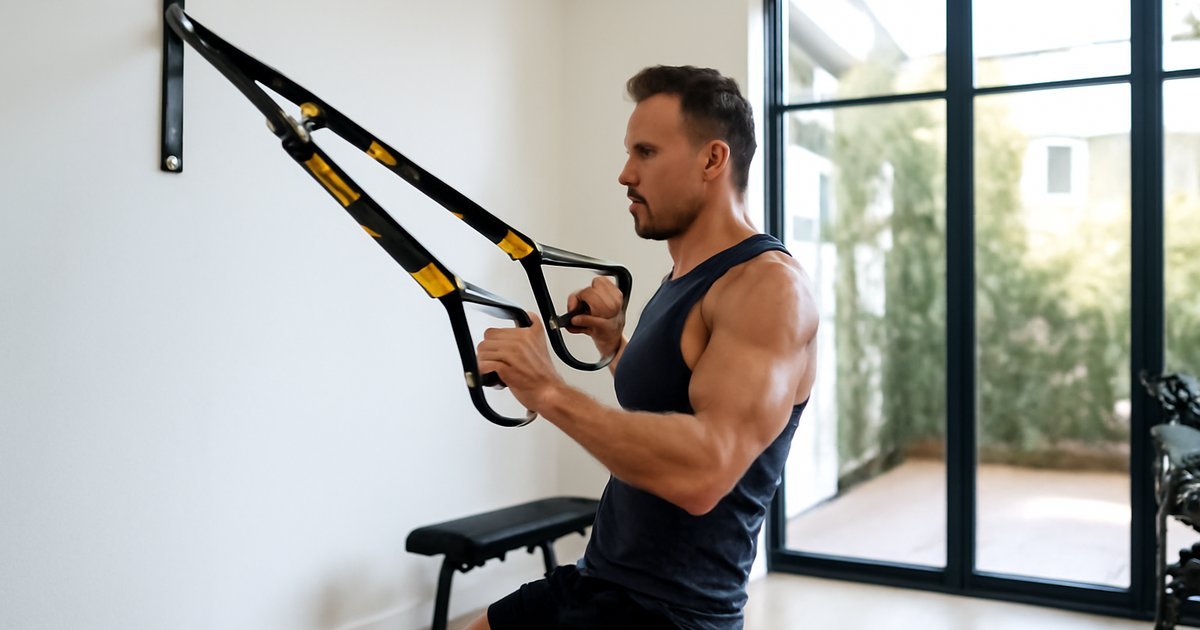
You don’t need a fully loaded gym to build real, functional strength — just two straps and the willingness to show up.
Picture this: you walk into a hotel gym, a friend’s garage, or your own living room, and within minutes you’re running a full-body workout with nothing but a pair of yellow straps anchored to a door or a pull-up bar. No machines, no plates, no excuses.
That’s exactly what TRX suspension training offers — and it’s one of the most underused tools in the fitness world for adults aged 25 to 60. While it was originally developed by a Navy SEAL for training in the field, suspension training has since earned serious credibility in physical therapy offices, athletic performance centers, and everyday home gyms across the country.
If you’ve been curious about TRX but weren’t sure where to start, whether it’s effective, or how it compares to traditional weightlifting, this guide breaks it all down. You’ll learn the science behind why it works, how to get started safely, what mistakes to avoid, and what realistic results look like over time.
Let’s get into it.
Why Suspension Training Matters More Than You Think
Most people still think of suspension trainers as a niche piece of gym equipment — something reserved for elite athletes or physical therapists. But the evidence suggests it deserves a much wider audience.
According to the American Council on Exercise (ACE), suspension training consistently activates the core musculature at significantly higher levels than many traditional floor-based exercises. In one ACE-commissioned study comparing TRX movements to conventional gym exercises, researchers found that TRX versions of common moves like push-ups and rows led to substantially greater core engagement — sometimes as much as 30% more activation compared to their standard counterparts.
Why does that matter for you? Because core stability isn’t just about abs. It’s the foundation of everything — injury prevention, posture, lifting power, and even how efficiently you move through daily life. When your core is stronger, your whole body works better.
Beyond core strength, suspension training builds what exercise scientists call neuromuscular coordination — the ability of your brain and muscles to communicate quickly and effectively. This is especially critical as we age, because loss of neuromuscular efficiency contributes directly to falls, joint instability, and declining functional movement. Research published in the Journal of Human Kinetics found that suspension training programs improved both strength and balance outcomes in adult participants across multiple age groups.
The bottom line: this isn’t a trendy fitness gimmick. It’s a well-supported training method with real, measurable benefits — and it scales to where you are right now, regardless of your current fitness level.
How TRX Suspension Training Actually Works
Here’s the core principle: instead of lifting a fixed external weight, your body becomes the resistance. The TRX straps anchor to a fixed point overhead, and you hold the handles while performing exercises at varying angles. The more horizontal your body position, the more of your bodyweight is working against you — making every move infinitely scalable.
A squat with 80% of your bodyweight loaded is very different from the same squat with 40%. That’s the beauty of angle manipulation in suspension training. You don’t need to change equipment — you just take a step forward or backward to increase or decrease the challenge.
One common myth worth busting: Many people assume TRX is only useful for beginners or rehabilitation. That’s simply not accurate. A 2019 study published in the International Journal of Sports Physical Therapy demonstrated that suspension training produced measurable gains in muscular endurance, balance, and functional strength in both sedentary adults and trained athletes — proving its value across the fitness spectrum.
The instability element is also doing real work. Because you’re never on a fully stable surface, your stabilizer muscles — the smaller, deeper muscles surrounding your joints — have to fire constantly throughout every rep. Traditional machines eliminate this instability intentionally, which is useful for isolation work, but also means those small stabilizers often go undertrained. Suspension training fills that gap.
It also offers a remarkably joint-friendly training environment. Because you control the angle and load at every point in the movement, there’s far less compressive force on the knees, hips, and lower back compared to heavy barbell lifts. For adults managing minor joint discomfort or returning from injury, this can be a significant advantage — though results vary significantly based on individual health status, and professional guidance is always recommended.
How to Get Started With Suspension Training
Starting with TRX doesn’t require a gym membership or a trainer — though both can accelerate your progress. Here’s a practical framework to get you moving safely and effectively.
What you need:
- A TRX or comparable suspension trainer (quality matters — avoid very cheap knockoffs that may have poor weight ratings)
- A sturdy anchor point: a door anchor kit, a squat rack, a pull-up bar, or a ceiling mount
- About 6-8 feet of clearance in front of the anchor point
- Athletic shoes with good grip
Beginner-Level Starter Routine (2-3 days per week):
- TRX Squat — Stand facing the anchor, hold straps at chest height, lower into a squat using the straps for balance support. 3 sets of 10-12 reps.
- TRX Row — Lean back with arms extended, pull your chest to the handles. The more horizontal you are, the harder it gets. 3 sets of 8-12 reps.
- TRX Push-Up — Hands in handles, body at an angle, perform a push-up. Steeper angle = easier. 3 sets of 8-10 reps.
- TRX Hip Hinge — Hold straps, hinge forward at the hips while keeping your spine neutral, then drive your hips forward to stand. 3 sets of 10 reps.
- TRX Plank Hold — Feet in the foot cradles, body in a plank position. Hold for 20-30 seconds, 3 sets.
Intermediate progression: Once these feel manageable, reduce your angle to increase load, add a pause at the bottom of each movement, or introduce single-leg and single-arm variations.
Advanced options: TRX pikes, atomic push-ups, single-leg squats with suspension assist, and power pulls all challenge even experienced athletes. These are also where pairing suspension training with other modalities — like bodyweight training or dumbbell work — can create a highly effective full-body program.
Common Mistakes That Sabotage Your Results
Suspension training looks simple — and in some ways, it is. But there are a handful of easy mistakes that will stall your progress or increase your injury risk if left unchecked.
1. Letting the straps go slack mid-movement
This is the most common beginner error. When there’s no tension in the straps, you lose stability and significantly reduce the effectiveness of the exercise. Always start each rep with the straps taut and maintain that tension throughout. If you can’t, you may be using too steep an angle — make the move easier until your form is solid.
2. Skipping the setup check
Anchor point failure is a real risk with suspension training. Before every workout, test your anchor by applying gradual load — don’t just assume the door anchor held from last week. Inspect the straps for fraying or damage periodically. This isn’t paranoia; it’s basic safety maintenance.
3. Rushing through reps with poor posture
Because suspension training is inherently unstable, momentum becomes a major compensation strategy for people who are fatigued or moving too fast. Slow, controlled reps with a neutral spine and engaged core will always outperform rushed, sloppy ones. Aim for a 2-second lowering phase on most movements.
4. Training too frequently without recovery
Suspension training is deceptively demanding on stabilizer muscles that aren’t used to this type of stress. Many beginners feel fine during the workout but are significantly sore two days later. According to the American College of Sports Medicine (ACSM), most adults benefit from 48 hours of recovery between sessions targeting the same muscle groups, especially in the first 4-6 weeks of a new program.
5. Sticking to the same angles indefinitely
Your body adapts quickly to fixed stimuli. If you’re doing the same TRX row at the same angle for months, you’re leaving progress on the table. Track your angles, rep counts, and tempo — and adjust them regularly to keep progressing.
What to Eat to Support Your Suspension Training Results
No training program outperforms a poor nutritional foundation. If you’re using suspension training to build strength and improve body composition, these evidence-backed nutrition principles from the Academy of Nutrition and Dietetics and the USDA Dietary Guidelines will support your progress.
Protein is non-negotiable. Muscle repair and growth require adequate protein intake. Research consistently supports a target of approximately 0.7 to 1.0 grams of protein per pound of body weight per day for active adults. Practical sources include chicken breast, eggs, Greek yogurt, canned tuna, legumes, and cottage cheese. Spread your intake across meals rather than loading it all at dinner.
Don’t fear carbohydrates before training. Glycogen — stored carbohydrate in your muscles — is your body’s preferred energy source during moderate to high intensity exercise. A light carbohydrate-containing snack 60-90 minutes before training (think a banana with almond butter or oatmeal with berries) can meaningfully improve your performance and delay fatigue.
Post-workout recovery window matters. Consuming a combination of protein (20-30g) and carbohydrates within 60-90 minutes of finishing your workout supports glycogen replenishment and muscle protein synthesis, according to research published in the Journal of the International Society of Sports Nutrition.
Hydration is a training variable. Even mild dehydration — as little as 2% of body weight — can reduce strength output and cognitive focus. Aim for half your bodyweight in ounces of water daily as a general baseline, and increase this on training days or in warm conditions.
Watch for under-fueling. Suspension training is physically demanding. Adults who consistently train while under-fueling often experience fatigue, poor recovery, mood changes, and plateau. Eating enough total calories to support your activity level is just as important as eating the right foods.
How Long Until You See Results and What to Track
Here’s the honest answer: it depends on your starting point, consistency, nutrition, sleep, and recovery. That said, there are some realistic general benchmarks supported by exercise science.
Weeks 1-2: You’ll likely notice improved coordination and body awareness as your nervous system learns the movements. Don’t be discouraged if you feel awkward early on — this is normal and it means adaptation is already happening.
Weeks 3-6: Most people start to notice improved muscular endurance, better posture, and reduced difficulty with everyday movements like carrying groceries or climbing stairs. These are functional gains that research identifies as early adaptations to resistance training.
Weeks 6-12: Visible strength improvements, changes in muscle tone, and measurable gains in balance and stability become apparent for consistent trainees. A 12-week suspension training study cited in the Journal of Human Kinetics found significant improvements in core strength and lower-body stability in adult participants who trained three times per week.
Metrics worth tracking:
- The angle at which you can perform each movement with good form
- Number of clean reps per set
- Time under tension (for plank holds and isometric moves)
- Perceived exertion and recovery time between sessions
- Qualitative measures: how you feel getting out of bed, climbing stairs, carrying things
When to reassess: If you’ve been consistent for 8-10 weeks and aren’t noticing any improvement, it may be time to revisit your nutrition, sleep quality, workout programming, or get an assessment from a certified personal trainer (look for NASM-CPT, ACSM-CPT, or ACE-CPT credentials).
If you enjoy combining this approach with other training styles, exploring balance training alongside TRX can amplify your stability gains significantly.
Frequently Asked Questions About TRX and Suspension Training
Is TRX suspension training good for weight loss?
Suspension training can support a weight loss goal as part of a broader strategy that includes a calorie-appropriate diet and regular physical activity. It builds lean muscle mass, which increases resting metabolic rate over time, and circuit-style TRX workouts can elevate your heart rate for a meaningful cardiovascular effect. That said, no single workout guarantees fat loss — energy balance and overall lifestyle factors are the dominant variables.
Can older adults or beginners use TRX safely?
Yes — and in many cases, TRX is actually more beginner-friendly than free weights because the angle can be adjusted to reduce load instantly. Older adults benefit from its joint-friendly design and the built-in balance challenge. However, anyone with a recent injury, osteoporosis, or a significant balance disorder should consult a healthcare provider or physical therapist before starting.
How does TRX compare to traditional weightlifting?
They complement rather than compete with each other. Suspension training excels at building core stability, neuromuscular coordination, and functional movement patterns. Traditional weightlifting tends to be more efficient for maximum strength and muscle hypertrophy in the long term. Many athletes and fitness enthusiasts use both. If you’re interested in adding free weights to your program, dumbbell training pairs especially well with TRX.
How many days per week should I do TRX?
For most adults, 2-3 non-consecutive days per week is a well-supported starting frequency. This allows adequate recovery between sessions, particularly for stabilizer muscles that are doing unusually high work during suspension exercises. As you adapt over several months, you may increase to 4 days using a split approach.
Do I need to buy an official TRX brand, or are cheaper options okay?
The TRX brand is the original and has the most extensive weight-testing and quality documentation. However, there are reputable alternatives from brands like Rogue and Jungle Gym that have also been independently tested. Be cautious with very low-cost options from unknown manufacturers, especially when purchasing through unverified channels — the anchor and strap integrity matters for your safety.
Conclusion
TRX suspension training won’t turn you into an athlete overnight — nothing honest will. But it is one of the most genuinely versatile, evidence-supported, and accessible strength training tools available to adults who want to build real functional strength without a complicated setup or a heavy equipment budget.
The key, as always, is consistency over intensity. Start with the basics, learn the movements with care, fuel your body well, and let your body adapt over time. Small improvements every week compound into remarkable progress over months.
Your next step is simple: anchor those straps, pick two exercises from the beginner list above, and get through your first session today. That’s how every meaningful fitness journey begins — not perfectly, just purposefully.
This article is for informational and educational purposes only. The content is not intended to replace professional medical, nutritional, or fitness advice. Always consult a qualified healthcare provider, registered dietitian, or certified fitness professional before starting a new health program or making significant changes to your lifestyle.
Content reviewed by our wellness editorial team, with references to peer-reviewed research and guidelines from leading health organizations.