Flexibility Training for Adults: Move Better, Feel Stronger
If bending down to tie your shoes leaves you winded — or your hips ache after sitting at a desk all day — flexibility training might be the missing piece in your wellness routine.
Why Most Adults Are Losing Flexibility Without Realizing It
Here’s a sobering truth: after age 30, adults can lose up to 10% of their muscle flexibility per decade if they don’t actively work to maintain it. That’s not a scare tactic — it’s a well-documented physiological reality confirmed by research published in the Journal of Aging and Physical Activity.
Most people don’t notice the gradual stiffness creeping in until something goes wrong — a pulled hamstring during a weekend jog, chronic lower back pain after long work hours, or simply the frustrating inability to reach overhead without wincing.
And yet, flexibility is one of the most neglected components of adult fitness. Unlike strength training or cardio, it rarely gets scheduled into the week. There’s no calorie counter for a hip flexor stretch. No leaderboard for a longer hamstring hold.
But here’s what the science keeps confirming: flexibility isn’t just about being able to touch your toes. It’s directly tied to injury prevention, joint health, posture, athletic performance, and even stress relief. In this guide, you’ll get a practical, evidence-based roadmap to start — or restart — a flexibility training routine that actually fits your life.
Why Flexibility Training Matters More Than You Think
Flexibility is formally defined by the American College of Sports Medicine (ACSM) as the ability of a joint or series of joints to move through an unrestricted, pain-free range of motion. It sounds clinical, but in everyday terms it means how freely and comfortably your body moves.
The stakes are higher than most people realize. According to the ACSM’s Health-Related Fitness guidelines, poor flexibility is a contributing risk factor for musculoskeletal injuries, chronic pain conditions, and even falls in older adults. In a population where back pain alone affects roughly 80% of Americans at some point in their lives (per the National Institutes of Health), that matters enormously.
Beyond injury prevention, flexibility training has been linked to improved circulation, reduced muscle soreness, better posture, and reduced tension headaches — all issues that affect busy adults in their prime working years.
There’s also an underappreciated connection between flexibility and stress. Research published in the Journal of Physical Therapy Science found that stretching activates the parasympathetic nervous system, helping lower cortisol levels and promote a calmer mental state. That means a 10-minute stretching session before bed isn’t just good for your hips — it may also help you sleep better.
The bottom line: flexibility training is a foundation, not an accessory. If you’re already doing compound exercises for full-body strength or following a mobility training program, adding structured flexibility work will amplify your results across the board.
The Science Behind Flexibility: How It Actually Works
Before diving into techniques, it helps to understand what’s actually happening in your body when you stretch. Muscles don’t work alone — they’re surrounded by connective tissue called fascia, and attached to bones via tendons. When you hold a stretch, you’re influencing all of these structures.
The primary mechanism behind improved flexibility is a reduction in neural inhibition. In simple terms, your nervous system limits how far a muscle stretches as a protective reflex. Regular stretching trains your brain to tolerate a greater range of motion over time — not just your tissues. This is why consistency matters more than intensity when it comes to flexibility gains.
Busting a common myth: Many people believe that stretching before a workout prevents injuries and improves performance. However, the research tells a different story. A landmark review published in the British Journal of Sports Medicine found that static stretching (holding a stretch for 30-60 seconds) performed immediately before exercise can actually temporarily reduce muscular strength and power output by up to 8%.
The better approach? Save static stretching for after workouts or as a standalone session. Before exercise, opt for dynamic stretching — controlled movements that take your joints through their range of motion, like leg swings, arm circles, and hip rotations. This primes the nervous system without compromising muscle performance.
There are three main types of flexibility training worth knowing:
- Static stretching: Hold a position for 20-60 seconds. Best for post-workout or dedicated sessions.
- Dynamic stretching: Controlled, movement-based. Ideal pre-workout warm-up.
- PNF stretching (Proprioceptive Neuromuscular Facilitation): Contract-relax technique, often done with a partner. Highly effective for rapid flexibility gains, but requires proper instruction.
Each has its place in a well-rounded program. For most adults starting out, static and dynamic stretching provide the best accessibility-to-results ratio.
How to Get Started: A Practical Flexibility Routine
The most important thing to know before you start: you don’t need to be flexible to start a flexibility program. That would be like needing to be strong before starting strength training. You simply begin where you are.
The ACSM recommends that adults perform flexibility exercises for all major muscle groups at least 2-3 days per week, with daily stretching being ideal for maximum benefit. Each stretch should be held for 10-30 seconds (building to 60 seconds over time), and repeated 2-4 times.
Beginner Level — The Daily 10-Minute Routine
Focus on the most commonly tight areas for desk workers and sedentary adults:
- Standing quad stretch — 30 seconds each side. Hold a wall if needed for balance.
- Standing hamstring stretch (forward fold) — 30-45 seconds. Keep knees slightly bent to protect your lower back.
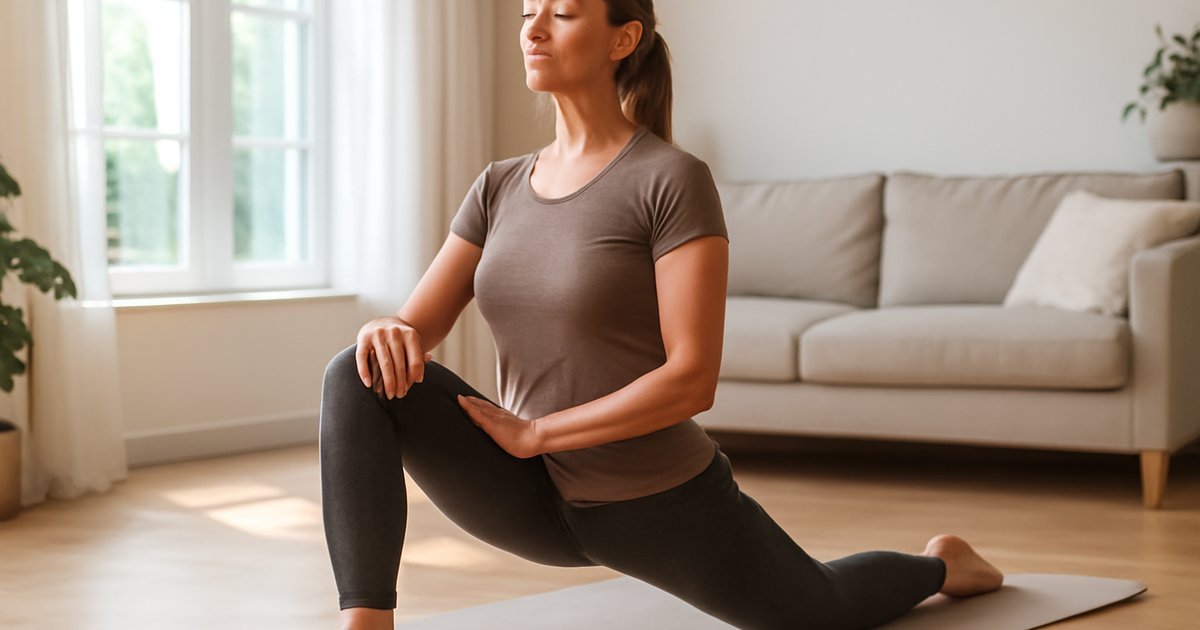
- Hip flexor lunge stretch — 30-45 seconds each side. Drop to one knee, shift your hips forward gently.
- Chest opener stretch — Clasp hands behind your back and gently open your chest. 30 seconds.
- Neck side stretch — Tilt ear toward shoulder, apply gentle pressure with hand. 20 seconds each side.
- Seated figure-four stretch — Cross one ankle over the opposite knee. Hold 30-45 seconds each side. Excellent for piriformis and hip rotators.
Do this sequence daily. Results won’t come overnight, but most people notice meaningful improvement in tightness and ease of movement within 3-4 weeks of consistent practice.
Intermediate Level
Once the beginner routine feels manageable, add:
- Extended hold times (45-60 seconds per stretch)
- Butterfly stretch for inner thighs and groin
- Pigeon pose (from yoga) for deep hip opening
- Doorway pectoral stretch for chest and shoulder health
- Supine spinal twist for thoracic and lumbar mobility
Advanced Level
Incorporate PNF techniques with a trained partner or coach, yoga flows that challenge end-range flexibility, and targeted active flexibility work (holding the stretched position using your own muscle strength rather than gravity or assistance).
If you’re already doing bodyweight training, adding this flexibility sequence as a cooldown is an efficient way to check both boxes in the same session.
Common Mistakes That Sabotage Your Flexibility Progress
Most adults who try flexibility training don’t fail because the approach is wrong — they fail because of entirely avoidable errors. Here are the most common ones:
Mistake 1: Bouncing through the stretch (ballistic stretching)
This feels natural — bouncing at the end range of a hamstring stretch, for example. But ballistic stretching triggers the stretch reflex, causing the muscle to contract rather than relax. It also raises your injury risk. Fix it: move into the stretch slowly, breathe into it, and hold without bouncing.
Mistake 2: Holding your breath
Tension and breath-holding go hand in hand, and they work against you in flexibility training. When you hold your breath, you increase muscular tension system-wide. Fix it: inhale slowly to prepare, then exhale as you deepen into the stretch. Use long, slow nasal breaths throughout each hold.
Mistake 3: Only stretching what’s already flexible
People tend to stretch what feels good, not what needs work. If your calves are naturally loose, you might ignore your tight hip flexors. Fix it: do a full-body flexibility assessment — or simply follow a structured routine that targets all major muscle groups equally.
Mistake 4: Inconsistency
Stretching once a week after an intense workout won’t move the needle. Flexibility requires consistent stimulus to adapt. Fix it: treat flexibility like brushing your teeth — a daily non-negotiable, even if it’s just 10 minutes. The ACSM specifically highlights frequency as the key variable in flexibility improvement.
Mistake 5: Stretching through sharp or acute pain
There’s a difference between the productive discomfort of a deep stretch and pain that signals tissue damage. Flexibility work should feel like a sustained, manageable pull — never a sharp, stabbing, or burning sensation. Fix it: if you feel sharp pain, back off immediately and consult a physical therapist before continuing.
What Supports Your Flexibility: Nutrition and Recovery Habits
Flexibility training doesn’t happen in a vacuum. Several nutritional and lifestyle factors directly affect how well your muscles and connective tissue respond to stretching.
Hydration matters more than most people think. Fascia and connective tissue are water-dependent structures. Dehydrated tissues are stiffer, less pliable, and more injury-prone. The National Academies of Sciences, Engineering, and Medicine recommends approximately 3.7 liters of total daily water intake for men and 2.7 liters for women (from all food and beverage sources combined).
Protein and collagen synthesis. Connective tissues — tendons, ligaments, and fascia — are largely made of collagen. The Academy of Nutrition and Dietetics highlights that adequate protein intake supports tissue repair and remodeling. Some research, including a study published in the American Journal of Clinical Nutrition, suggests that vitamin C-enriched collagen supplements taken before training may support collagen synthesis in tendons and ligaments — though more research is needed.
Anti-inflammatory foods. Chronic low-grade inflammation can increase muscle stiffness and reduce range of motion over time. Diets rich in omega-3 fatty acids (from salmon, sardines, walnuts, and flaxseed), colorful vegetables, and polyphenol-rich foods like blueberries and olive oil are associated with lower systemic inflammation according to research cited by Harvard Health Publishing.
Magnesium. This essential mineral plays a role in muscle relaxation and neuromuscular function. According to the NIH, many American adults fall short of recommended magnesium intake. Foods like spinach, pumpkin seeds, black beans, and almonds are excellent dietary sources.
Sleep and recovery. Much of the tissue adaptation from flexibility training happens during sleep. Consistently poor sleep can impair connective tissue recovery and increase perceived muscle tightness. Prioritizing 7-9 hours per night (per the National Sleep Foundation) is a legitimate part of your flexibility strategy.
How Long Until You See Real Results — and What to Track
Flexibility gains are real, measurable, and often faster to achieve than most people expect — but they do require patience and consistency.
Research published in the Journal of Strength and Conditioning Research found that participants who stretched 5 days per week for 6 weeks showed significant improvements in hamstring flexibility compared to those who stretched 2-3 days per week. The takeaway: frequency is the most powerful lever you can pull.
Realistic timelines:
- Week 1-2: Reduced muscle tightness and tension. You’ll feel it, even if you can’t measure it.
- Week 3-4: Noticeable improvement in range of motion for key areas like hamstrings, hip flexors, and shoulders.
- Week 6-8: Measurable flexibility gains. This is when most people start seeing objective changes (can reach further, move more freely).
- Month 3+: Sustained improvement in functional movement, posture, and reduction in everyday aches and stiffness. Results vary based on age, starting flexibility, and consistency.
What to track:
- Sit-and-reach test: A classic benchmark for hamstring and lower back flexibility. Measure weekly.
- Shoulder flexibility: Can you clasp your hands behind your back? Note which side is tighter.
- Hip flexibility: How far can you drop into a hip flexor lunge before feeling the stretch? Track progressively.
- Subjective tightness rating: Rate morning stiffness on a scale of 1-10. This simple self-measure is surprisingly valuable over time.
If you’re not seeing any improvement after 8 weeks of consistent effort, consider consulting a physical therapist. Some stiffness is related to joint structure, past injuries, or neuromuscular patterns that benefit from professional assessment.
Frequently Asked Questions About Flexibility Training
Is it too late to start flexibility training after 40 or 50?
Absolutely not. While connective tissue does become less elastic with age, research consistently shows that adults of all ages respond positively to regular stretching. A study in the Journal of Aging and Physical Activity found significant flexibility improvements in adults aged 40-70 after a 12-week stretching program. Starting later simply means starting — and every week of consistency moves you forward.
How long should I hold each stretch?
The ACSM recommends holding static stretches for 10-30 seconds at minimum, building toward 60 seconds as you progress. Shorter holds (under 10 seconds) provide minimal lasting benefit. For most adults, 30-45 seconds per stretch, repeated 2-3 times, is the practical sweet spot.
Can flexibility training help with lower back pain?
For many adults, yes — particularly when the pain is related to tight hip flexors, hamstrings, or thoracic stiffness. The Mayo Clinic notes that targeted stretching is a common component of back pain management programs. However, some back conditions require specific movement precautions, so always consult your healthcare provider before beginning if you have existing back issues.
Should I stretch every day?
Daily stretching is ideal and generally safe. Unlike strength training, flexibility training doesn’t require recovery days between sessions — gentle daily stretching can actually accelerate progress. The exception is if a specific area is acutely sore or injured, in which case rest and professional guidance are appropriate.
Does yoga count as flexibility training?
Yes, with important nuance. Yoga incorporates static flexibility work, dynamic movement, balance, and sometimes strength — making it an excellent complementary practice. Research published in PLOS ONE found that regular yoga practice significantly improved flexibility and balance in adults. However, yoga alone may not address all tight areas systematically, which is why a dedicated stretching routine remains valuable alongside it.
The Takeaway: Small Stretches, Big Payoffs
Flexibility training isn’t glamorous. It won’t make headlines the way a new HIIT protocol does. But day after day, it quietly does something profound — it keeps your body moving freely, reduces pain, improves your posture, and makes every other form of exercise more effective and enjoyable.
You don’t need an hour-long yoga class or a personal trainer on day one. You need 10 consistent minutes, a clean stretch sequence, and the patience to show up regularly. Start with the beginner routine in this guide. Do it after your next workout or right before bed tonight.
Your future self — the one who bends down without groaning, reaches overhead without wincing, and moves through the day with ease — will thank you for the small, boring, completely life-changing choice you made today.
Wellness Disclaimer: This article is for informational and educational purposes only. The content is not intended to replace professional medical, nutritional, or fitness advice. Always consult a qualified healthcare provider, registered dietitian, or certified fitness professional before starting a new health program or making significant changes to your lifestyle.
Content reviewed by our wellness editorial team, with references to peer-reviewed research and guidelines from leading health organizations.