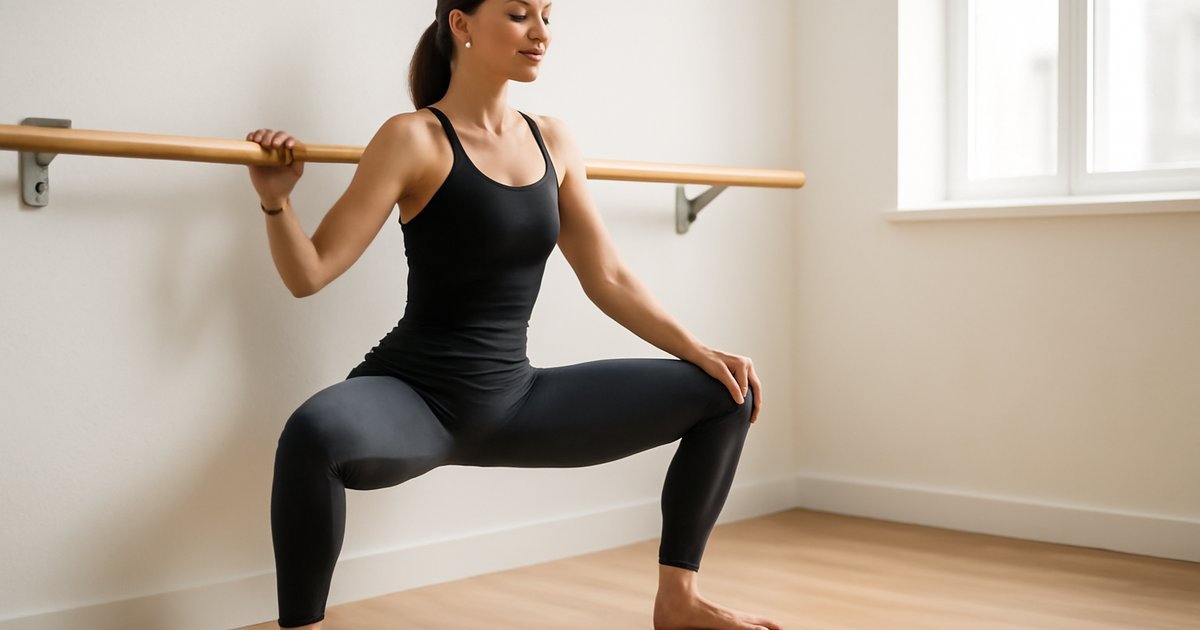
You don’t need a ballet background — or even good coordination — to get a seriously effective workout from barre.
Picture this: you’re standing at a sturdy chair, doing tiny pulsing movements with your thighs burning like you just ran a mile — and you haven’t moved more than an inch. That’s the paradox of barre workouts, and it’s exactly why millions of adults have added this low-impact, high-intensity method to their fitness routine.
Barre training has evolved far beyond its dance-studio roots. Today, it’s one of the most accessible and effective ways for adults to build muscular endurance, improve posture, and develop the kind of functional strength that makes everyday life easier. Whether you’re completely new to structured exercise or looking to complement your existing routine, barre offers something genuinely different — and the science backs it up.
In this guide, you’ll learn what barre workouts actually do to your body, how to start safely, the most common mistakes beginners make, and what realistic results look like over time. No tutus required.
Why Barre Workouts Matter More Than You Think
Most people assume barre is just a trendy fitness class for dancers. In reality, it’s a discipline rooted in rehabilitation science, ballet technique, and resistance training — a combination that produces measurable results for adults at nearly every fitness level.
What makes barre particularly valuable is its emphasis on isometric contractions and small-range-of-motion movements. Rather than large, dynamic lifts, barre targets muscles through sustained holds and micro-pulses that keep fibers under tension far longer than typical reps. This prolonged time under tension is a key driver of muscular endurance and hypertrophy, according to research published in the Journal of Strength and Conditioning Research.
According to the American College of Sports Medicine (ACSM), adults should engage in muscle-strengthening activities at least two days per week. Barre qualifies — and because it’s low-impact and joint-friendly, it’s especially relevant for the 54 million Americans dealing with some form of arthritis or joint discomfort, per the CDC.
Beyond strength, barre builds something that most gym programs overlook: body awareness. The controlled, precise movements train your nervous system to engage the right muscles at the right time — a quality that directly reduces injury risk in daily life, whether you’re carrying groceries or climbing stairs.
The Science Behind How Barre Actually Works
Here’s the most common misconception about barre: because the movements are small and there’s no heavy lifting, people assume it’s not a "real" workout. That’s simply not true — and the physiology explains why.
Barre’s signature technique — the isometric hold followed by rapid micro-pulses — creates a sustained recruitment of slow-twitch and fast-twitch muscle fibers simultaneously. A 2021 study published in the International Journal of Exercise Science found that isometric training at moderate intensities produced significant gains in muscular endurance and functional strength in adults aged 30–60, comparable to traditional resistance training protocols.
The "shake" you feel during a barre hold isn’t weakness — it’s your muscle fibers reaching fatigue and recruiting deeper motor units to compensate. That’s exactly the mechanism that drives strength and endurance adaptations over time.
Barre also has a meaningful cardiovascular component. A study from the Journal of Dance Medicine and Science found that a 60-minute barre class elevated participants’ heart rates to 55–75% of maximum heart rate — well within the aerobic training zone recommended by the American Heart Association for cardiovascular health.
The myth to bust: Barre will make women "bulky." Because barre uses bodyweight and light resistance at high repetitions, it builds lean muscular endurance — not large muscle mass. The hormonal and mechanical conditions that drive significant hypertrophy simply aren’t present in a standard barre session.
How to Get Started with Barre Training
One of barre’s biggest advantages is how accessible it is from day one. You don’t need special equipment, a dance background, or even a class — though all of those can help.
What you’ll need to begin:
- A sturdy chair, countertop, or wall to use as your "barre"
- Non-slip socks or bare feet on a yoga mat
- Comfortable, form-fitting clothing so you can see your alignment
- Optional: light resistance bands or 2–5 lb dumbbells for upper body work
Beginner Level — Weeks 1–3:
- Start with 2 sessions per week. Give your muscles — especially your hips, inner thighs, and core — time to adapt. Delayed onset muscle soreness (DOMS) from barre can be surprisingly intense for new practitioners.
- Focus on alignment first. A neutral spine, engaged core, and level hips are the foundation of every barre exercise. Form matters far more than depth or range of motion.
- Try a beginner-friendly 20-minute routine. Key movements: parallel and turnout plié squats, relevé holds, glute bridges, and tabletop leg lifts. Hold each position for 30–45 seconds before pulsing.
- Use a mirror if possible. Barre is highly technique-dependent. Visual feedback helps you catch misalignments early.
Intermediate Level — Weeks 4–8:
- Increase sessions to 3–4 per week and extend class duration to 45–60 minutes.
- Introduce arabesque holds, passé balance work, and single-leg variations to build stability and challenge your core more deeply.
- Add a resistance band around your thighs during glute and hip work to increase intensity without adding impact.
Advanced Options: Incorporate elevated barre work (on demi-pointe), increased time under tension (60+ second holds), and flowing sequences that elevate heart rate. Consider classes that blend barre with Pilates or HIIT for greater metabolic demand. If you’re looking for complementary low-impact training, Pilates for Adults pairs particularly well with barre programming.
Common Mistakes That Sabotage Your Barre Results
Barre looks deceptively simple — and that’s exactly what makes it easy to do wrong. These mistakes are incredibly common, even among people who’ve been practicing for months.
1. Gripping the barre too tightly.
The chair or barre is there for light balance support — not to bear your weight. When you grip it hard, you shift load away from your legs and core, reducing the exercise’s effectiveness by a significant margin. Fix it: rest just two or three fingers on the surface, as if you’re lightly touching a banister.
2. Letting the lower back arch during seat work.
During glute exercises like arabesque lifts or hydrant pulses, many people arch the lumbar spine to get more range of motion. This strains the lower back and disengages the glutes entirely. Fix it: actively tuck your pelvis slightly and maintain a "long spine" throughout. Smaller range with better form will always produce better results.
3. Not engaging the core consistently.
Barre is fundamentally a core workout disguised as a lower body workout. If your abdominals aren’t actively braced throughout every movement, you’re missing half the training stimulus. Fix it: before each exercise, take a breath in, exhale, and draw your navel gently toward your spine. Maintain that engagement throughout.
4. Rushing through the pulses.
The micro-pulse is barre’s defining technique, and it only works when done slowly and with control. Fast, sloppy pulses use momentum instead of muscle. Fix it: think "one inch up, one inch down" with complete muscular control on both the up and down phase.
5. Skipping the stretching segment.
Barre classes always end with targeted stretching — and it’s not optional filler. The muscles you’ve worked through sustained contractions need lengthening to recover properly and maintain flexibility. According to the American College of Sports Medicine, post-exercise stretching held for 15–30 seconds significantly improves flexibility over time. Don’t leave early. If mobility is a priority for you, pairing barre with a dedicated foam rolling recovery routine can further accelerate your progress.
What to Eat to Support Your Barre Training
Barre is a muscular endurance workout, which means your nutritional focus should support muscle recovery and sustained energy — not extreme caloric restriction.
Protein: The Academy of Nutrition and Dietetics recommends 1.2–1.7 grams of protein per kilogram of body weight for adults engaged in regular resistance training. For a 150 lb adult, that’s approximately 82–116 grams per day. Good sources: Greek yogurt, eggs, chicken breast, lentils, cottage cheese, and edamame.
Pre-workout fuel (1–2 hours before): A small meal combining complex carbohydrates and protein supports performance during sustained isometric work. Examples: a banana with almond butter, oatmeal with berries, or whole-grain toast with cottage cheese.
Post-workout recovery (within 45 minutes): Pair fast-digesting carbohydrates with protein to replenish glycogen and support muscle repair. A fruit-and-protein smoothie, Greek yogurt with fruit, or a rice cake with turkey and avocado all work well.
Hydration: Even though barre isn’t high-sweat like a spin class, you’re still losing fluid through sustained muscular effort. The National Academies recommends approximately 2.7 liters (91 oz) of total water daily for women and 3.7 liters (125 oz) for men — more if you’re active.
What to avoid: Heavy meals within 60 minutes of class — they can cause discomfort during core and abdominal work. Also minimize refined sugar before sessions, as blood sugar spikes followed by crashes will undermine endurance during long isometric holds.
How Long Until You See Results — and What to Track
This is where honesty matters most, because barre results are real — but they don’t show up the way many people expect.
Weeks 1–2: You’ll likely feel increased muscular soreness, especially in your inner thighs, glutes, and postural muscles. This is normal and a sign that you’re activating underused muscle groups. Don’t expect visible changes yet.
Weeks 3–6: Most practitioners report noticeable improvements in posture, core stability, and balance. Harvard Health Publishing notes that muscular endurance improvements are often felt before they’re visible — you’ll notice you can hold positions longer and with less shaking.
Weeks 6–12: With consistent 3–4 sessions per week, you can expect visible muscle tone, particularly in the glutes, thighs, and arms. Body composition changes are modest compared to higher-intensity training, but postural transformation can be significant and lasting.
What to track:
- How long you can hold a barre position before form breaks down
- Posture improvements (photograph your side profile monthly)
- Balance — can you hold a single-leg relevé for 15, 30, then 45 seconds?
- Energy levels and how you feel during daily activities
- Range of motion in hips, hamstrings, and shoulders
When to reassess: If after 8 weeks of consistent training you feel no improvement in strength or endurance, consider increasing session frequency, adding resistance bands, or consulting a certified fitness professional to review your form. Results vary significantly depending on your baseline fitness, nutrition, and recovery quality. For a different kind of low-impact challenge that complements barre well, consider exploring Balance Training for Adults.
Frequently Asked Questions About Barre Workouts
Is barre good for weight loss?
Barre can contribute to a healthy weight management strategy, but it’s not primarily a calorie-burning workout. A 60-minute class burns approximately 300–400 calories on average, according to estimates from the American Council on Exercise. Its bigger contribution to body composition is building lean muscle mass, which supports a healthier metabolic rate over time. Pair barre with cardio training and a balanced diet for weight loss goals.
Can men benefit from barre training?
Absolutely. Barre addresses flexibility deficits, hip mobility, and postural imbalances that are extremely common in men — particularly those who do heavy lifting or sit for long periods. The hip flexor, inner thigh, and spinal stabilizer work in barre directly addresses weak points in most male athletic profiles. The only barrier is perception, not physiology.
How is barre different from Pilates?
Both disciplines emphasize core stability, controlled movement, and postural alignment — but their methods differ. Pilates uses specialized equipment (or a mat) and focuses heavily on spinal mobility and deep core engagement. Barre uses a vertical support structure, incorporates more standing lower-body work, and often includes a more significant cardiovascular element. Many adults find them highly complementary.
Is barre safe if I have knee or hip issues?
For many people with mild joint discomfort, barre’s low-impact nature makes it a safer option than high-intensity training. However, some movements — like deep plié squats or wide turnout positions — can stress vulnerable joints if done incorrectly. Always consult your physician or physical therapist before starting if you have a diagnosed condition, and work with a certified instructor who can modify exercises appropriately.
Do I need to take classes, or can I practice barre at home?
Both work. Online platforms and apps offer guided barre classes that are very effective for home practice. That said, in-person instruction is valuable early on because form feedback is difficult to self-correct. If you start at home, use a mirror and record yourself occasionally to check alignment.
Start Small, Stay Consistent, See Real Change
Barre isn’t a fitness trend — it’s a time-tested method that builds the kind of strength, stability, and body control that makes you feel better in your everyday life. The "burn" is real, the results are real, and the barrier to entry is remarkably low.
You don’t need to be flexible, coordinated, or in peak shape to begin. You just need a chair, a small patch of floor, and the willingness to show up consistently. Two sessions this week is a better starting point than waiting for the perfect moment.
Start with one 20-minute beginner routine today. Notice how your body feels afterward. That’s your data point — and your first step toward something genuinely sustainable.
This article is for informational and educational purposes only. The content is not intended to replace professional medical, nutritional, or fitness advice. Always consult a qualified healthcare provider, registered dietitian, or certified fitness professional before starting a new health program or making significant changes to your lifestyle.
Content reviewed by our wellness editorial team, with references to peer-reviewed research and guidelines from leading health organizations.