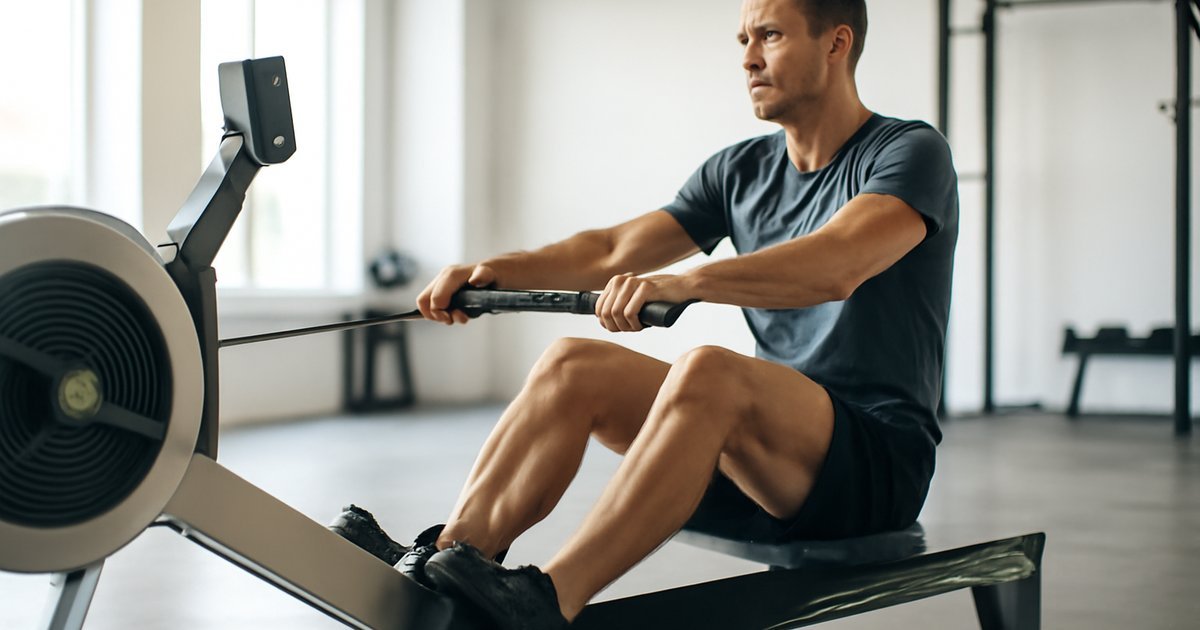
Rowing Machine Workout for Adults: Full-Body Results
Most people walk right past the rowing machine at the gym — and it might be the single biggest fitness mistake they’re making.
You’ve probably seen it sitting in the corner of your gym, slightly dusty, largely ignored while the treadmills and ellipticals are packed. The rowing machine doesn’t get the marketing love it deserves — and that’s a shame, because study after study confirms it’s one of the most efficient, low-impact, full-body workouts available to adults of any fitness level.
Here’s the truth: a single rowing session engages roughly 86% of the muscles in your body. That includes your legs, glutes, core, back, shoulders, and arms — all working together in one fluid, rhythmic motion. Whether your goal is fat loss, cardiovascular conditioning, muscle endurance, or simply getting more done in less time, rowing machine workouts deliver.
This guide is for adults aged 25 to 60 who want a smarter approach to cardio — something that doesn’t beat up your joints, doesn’t bore you to tears, and actually produces measurable results. We’ll cover the science, the technique, the most common mistakes, and how to build a rowing routine that fits your real life.
Why Rowing Machine Workouts Matter More Than You Think
If you’ve been sticking to the same cardio machine for years and feeling like your results have plateaued, you’re not alone. Most adults fall into a routine that stops challenging their body after a few weeks. The rowing machine breaks that pattern in a uniquely effective way.
According to the American College of Sports Medicine (ACSM), total-body cardiovascular exercise — the kind that recruits both upper and lower body simultaneously — produces superior caloric expenditure and cardiovascular adaptation compared to single-limb exercises like cycling or walking. Rowing fits that profile perfectly.
A 155-pound adult rowing at moderate intensity can burn approximately 260 to 316 calories in 30 minutes, depending on stroke rate and resistance, according to data from Harvard Health Publishing. At vigorous intensity, that number climbs significantly higher.
But calorie burn is only part of the story. Rowing also strengthens the posterior chain — the often-neglected muscles along your back, glutes, and hamstrings that are critical for posture, injury prevention, and long-term mobility. For desk workers and anyone who spends hours seated, this is particularly valuable.
And because rowing is non-weight-bearing and low-impact on the joints, it’s an excellent option for adults managing knee discomfort, hip tightness, or recovering from lower-body strain — though individual suitability always depends on your specific situation and should be evaluated by a healthcare professional.
The Science Behind Rowing: How It Actually Works
One of the biggest misconceptions about rowing is that it’s primarily an upper-body workout — something for rowers and athletes. In reality, proper rowing technique is about 60% legs, 20% core, and 20% arms. If you’re only feeling it in your shoulders and biceps, your form needs attention.
The rowing stroke follows a four-phase sequence: the catch, the drive, the finish, and the recovery. In the catch phase, you’re coiled at the front of the machine with knees bent, shins vertical, and core engaged. The drive initiates with a powerful leg press — not a pull. As your legs extend, your core braces and your torso leans back slightly. Only then do your arms draw the handle toward your lower ribcage. The finish, recovery, and return to the catch complete the cycle.
A study published in the Journal of Strength and Conditioning Research found that indoor rowing at moderate intensity produced significant improvements in VO2 max — a key marker of cardiovascular fitness — after just 8 weeks of consistent training. Participants also showed measurable improvements in muscle endurance across the back, core, and lower body.
The myth that rowing is bad for your back deserves a direct rebuttal: when performed with proper form, rowing actually strengthens the muscles that support spinal health. The problem arises when people round their lower back or yank with their arms — a technique error, not an inherent risk of the exercise itself.
Another advantage of rowing is its built-in intensity control. By adjusting the damper setting (resistance on air rowers) and your stroke rate (strokes per minute, or SPM), you can dial this workout from a gentle aerobic session to a high-intensity interval challenge — all on the same machine.
How to Get Started: Practical Steps for Every Level
The rowing machine has a slight learning curve, but most adults feel comfortable with the basic mechanics within two or three sessions. Here’s how to approach it based on where you’re starting from.
Before Your First Session:
- Adjust the footplates so the strap crosses over the widest part of your foot (the ball of your foot).
- Set the damper between 3 and 5 for beginners — higher isn’t always better; it mimics rowing a heavier boat and requires more strength than new rowers typically have.
- Sit tall, shoulders relaxed, and grip the handle loosely — not with a white-knuckle squeeze.
Beginner: Weeks 1–3
- Row for 10 to 15 minutes at a comfortable, conversational pace (18–22 SPM).
- Focus entirely on form — legs drive first, then core, then arms on the way out; reverse that order on the way back.
- Take 60-second rest breaks every 5 minutes if needed.
- Aim for 2 to 3 sessions per week.
Intermediate: Weeks 4–8
- Extend sessions to 20–30 minutes of continuous rowing.
- Introduce stroke rate variation: 2 minutes at 22 SPM, 1 minute at 26–28 SPM, repeat.
- Begin tracking your 500-meter split time (displayed on the monitor) as a benchmark for improvement.
- Add a second rowing day, targeting 3 to 4 sessions per week.
Advanced: Beyond Week 8
- Incorporate structured interval sessions: 8 x 250 meters with 90 seconds rest, or 4 x 500 meters with 2 minutes rest.
- Experiment with pyramid workouts: row 1 minute hard, 1 minute easy; 2 minutes hard, 2 minutes easy; up to 5 minutes hard, then back down.
- Consider pairing rowing with interval training principles to structure progressive sessions that keep your body adapting.
Common Mistakes That Sabotage Your Rowing Results
Even enthusiastic beginners fall into predictable traps on the rowing machine. The good news: every one of these is fixable once you know what to look for.
Mistake 1: Using your arms before your legs.
This is the most widespread form error in rowing. If you pull the handle toward you before your legs are fully extended, you lose the primary power source of the stroke — your legs — and put all the strain on your arms and lower back. The fix: think "legs, lean, arms" on the drive, and "arms, lean, legs" on the recovery. Drill this sequence slowly until it becomes automatic.
Mistake 2: Setting the damper too high.
A damper set at 10 feels more intense, which leads many beginners to assume it’s more effective. It’s not — at least not the way you’d hope. A high damper creates excessive drag, which slows your stroke and prioritizes raw strength over cardiovascular efficiency. Most experienced rowers train at a damper setting of 3 to 5. It feels lighter but requires a faster, more powerful stroke — which is actually harder on your cardiovascular system.
Mistake 3: Rowing at one constant pace every session.
Steady, low-effort rowing has its place — but doing nothing else means your body adapts quickly and your fitness stalls. Varying your intensity across sessions (some easy, some moderate, some hard intervals) is what drives continued improvement, according to principles outlined by the ACSM’s guidelines on aerobic training progression.
Mistake 4: Ignoring posture during fatigue.
As you get tired, the lower back tends to round and the shoulders hunch forward. This is when injury risk rises. If your form breaks down significantly, it’s better to stop, rest 60 to 90 seconds, and resume with proper mechanics than to grind through poor movement patterns. Fatigued, sloppy rowing is how people develop back soreness that gets attributed to the machine rather than the technique.
Mistake 5: Skipping the warm-up.
Jumping onto the rower and immediately hammering hard intervals is a recipe for muscle soreness and potential strain. Spend the first 3 to 5 minutes at an easy pace (18–20 SPM) to lubricate joints, raise core temperature, and establish your stroke rhythm before adding intensity.
What to Eat Before and After Rowing Workouts
Rowing is a metabolically demanding exercise that uses both aerobic and anaerobic energy systems, so fueling appropriately makes a real difference in performance and recovery.
Pre-workout (1–2 hours before): Aim for a small, balanced meal with moderate carbohydrates and protein. A bowl of oatmeal with a hard-boiled egg, or Greek yogurt with fruit, gives you sustained energy without digestive discomfort during the session. The Academy of Nutrition and Dietetics recommends 1 to 4 grams of carbohydrate per kilogram of body weight in the hours before moderate-intensity exercise.
If rowing first thing in the morning: A small carbohydrate snack 30 minutes before — half a banana, a slice of whole grain toast — can support performance without heaviness. Some people row well in a fasted state; results vary significantly depending on your fitness level and morning intensity.
Post-workout (within 30–60 minutes): Prioritize protein for muscle repair and carbohydrates to replenish glycogen. A protein shake with a piece of fruit, or a chicken and rice bowl, are practical choices. Research published in the Journal of the International Society of Sports Nutrition supports consuming 20 to 40 grams of protein after resistance-based and endurance exercise to optimize muscle protein synthesis.
Hydration: Rowing produces significant sweat output, especially during intense sessions. The USDA Dietary Guidelines and ACSM both recommend maintaining consistent fluid intake throughout the day, and replacing fluid losses during and after exercise. A practical starting point: drink 16 to 20 ounces of water 1 to 2 hours before rowing, and continue hydrating throughout your session.
How Long Until You See Results — and What to Track
Realistic timelines matter. Setting honest expectations keeps you consistent when early progress feels invisible.
Weeks 1–2: You’ll feel the workout — muscle fatigue, elevated heart rate, and possibly some soreness in your lats, glutes, and core. This is normal adaptation. Don’t judge your progress by how you feel yet.
Weeks 3–4: Most beginners notice improved cardiovascular endurance — sessions that felt difficult start to feel more manageable. Your stroke becomes more fluid and efficient. If you’re tracking your 500-meter split time, you’ll likely see it drop.
Weeks 6–8: This is typically when visible and measurable changes appear — improved posture, a stronger back and core, and for those also managing their nutrition, potential changes in body composition. A study in the Journal of Strength and Conditioning Research noted meaningful cardiovascular improvements after 8 weeks of consistent rowing at 3 sessions per week.
What to track:
- 500-meter split time — your average time to row 500 meters; a key rowing performance benchmark
- Total meters per session — a simple indicator of volume
- Resting heart rate — drops as your cardiovascular fitness improves
- How you feel at a fixed effort level — if 22 SPM feels easier than it did three weeks ago, that’s progress
If you’re combining rowing with strength training, consider pairing it with foundational movements. Resources on dumbbell training for adults and kettlebell training complement rowing well, addressing muscle groups that rowing doesn’t isolate as directly.
When to reassess or seek guidance: if you experience persistent lower back pain, sharp joint discomfort, or your performance stops improving after 8 to 10 weeks of consistent effort, consult a certified personal trainer or physical therapist to evaluate your form and programming.
Frequently Asked Questions
Is the rowing machine good for weight loss?
Rowing can absolutely support a weight loss goal, primarily because it burns a meaningful number of calories while also building muscle — and more muscle means a higher resting metabolic rate over time. That said, exercise alone rarely produces significant fat loss without corresponding attention to nutrition. Rowing works best as part of a broader lifestyle approach that includes a balanced, moderate calorie intake.
Is rowing safe if I have lower back problems?
It depends on the nature and severity of your back issue. For many adults with mild chronic lower back tightness, rowing with correct form actually strengthens the supporting muscles and reduces discomfort over time. However, if you have a diagnosed disc injury, spinal stenosis, or acute back pain, you should get clearance from your physician or physical therapist before rowing. Never push through sharp or radiating back pain.
How many days a week should I row?
For general fitness, 3 to 4 days per week is a solid target for most adults. This allows enough volume for cardiovascular adaptation while giving your muscles — especially the back and legs — adequate recovery time. Beginners may do well starting with 2 days per week and building up gradually.
Can rowing replace all my cardio?
For many people, yes — rowing covers all the bases of cardio fitness: aerobic endurance, muscular endurance, and high-intensity conditioning. However, varied movement patterns are always beneficial for long-term health. Mixing rowing with walking, cycling, or other low-impact activities keeps your body adaptable and reduces overuse patterns.
What’s a good rowing workout for complete beginners?
Start with a simple 15-minute session: 3 minutes easy rowing at 18–20 SPM, 1 minute slightly harder at 22–24 SPM, and repeat this pattern three times. Keep the damper between 3 and 5, focus entirely on letting your legs lead the stroke, and track how your body feels throughout. Simple, structured, and sustainable is the right starting point.
Start Rowing — One Stroke at a Time
The rowing machine isn’t a secret, but it might as well be — because most people walk past it without ever experiencing what it can do for their fitness. Full-body engagement, low joint impact, scalable intensity, and genuine cardiovascular challenge. It checks every box a busy adult needs from a workout.
You don’t need to be an athlete or a competitive rower to benefit. You just need to show up, learn the stroke, and stay consistent. Progress on the rowing machine is measurable, tangible, and — for most people — surprisingly fast.
Your action step for today: if you have access to a rowing machine, commit to one 10-minute form-focused session this week. Just focus on the sequence — legs, core, arms. Everything else builds from there.
This article is for informational and educational purposes only. The content is not intended to replace professional medical, nutritional, or fitness advice. Always consult a qualified healthcare provider, registered dietitian, or certified fitness professional before starting a new health program or making significant changes to your lifestyle.
Content reviewed by our wellness editorial team, with references to peer-reviewed research and guidelines from leading health organizations.