Balance Training for Adults: Stability, Strength & Longevity
You don't have to fall to realize your balance needs work — but most people wait until they do.
Here's a number that stops a lot of people mid-scroll: according to the Centers for Disease Control and Prevention, falls are the leading cause of injury-related death among adults over 65 in the United States — and the decline in balance that makes falls more likely begins much earlier, often in your 30s and 40s, long before most people start paying attention.
But balance training isn't just a concern for older adults. Whether you're 32 and playing weekend basketball, 47 and noticing you wobble getting out of bed, or 58 and serious about staying injury-free, your balance is a direct reflection of your neuromuscular health — and it's trainable at any age.
This guide breaks down exactly why balance training matters, how your body maintains stability, what the science says about improving it, and how to build a realistic practice into your week — even if you've never done a single balance drill in your life. No special equipment required to start.
Why Balance Training Matters More Than You Think
Balance is one of those fitness qualities that gets taken for granted until something goes wrong. Most people focus on strength, cardio, or flexibility — and stop there. But balance is actually the foundation that makes all of those other qualities functional and safe.
Your ability to maintain stability depends on a three-way communication system between your visual input (eyes), vestibular system (inner ear), and proprioceptive feedback (sensory signals from muscles, joints, and tendons). When these systems are well-trained and in sync, you move through space efficiently and safely. When they're neglected, the risk of missteps, stumbles, and injury increases significantly — even during everyday activities.
Research published in the British Journal of Sports Medicine found that adults who could not balance on one leg for at least 10 seconds showed a significantly higher risk of all-cause mortality over a 12-year follow-up period. That single finding reframes balance training from a "nice to have" into a genuine longevity marker.
The good news? The proprioceptive and neuromuscular systems respond well to targeted training. You can improve balance at 35, 50, or 65 — the timeline just changes slightly based on your starting point.
The Science Behind Balance — and Why It Declines With Age
A common misconception is that losing balance is simply "getting older." It's not inevitable — it's largely a result of inactivity and the gradual reduction of proprioceptive input that comes with a sedentary lifestyle.
After age 40, adults begin losing proprioceptive sensitivity at a measurable rate. The neuromuscular signals that coordinate rapid postural corrections slow down, reaction time decreases, and the stabilizing muscles around the ankles, hips, and core weaken if they're not specifically trained. This is compounded by the natural loss of fast-twitch muscle fibers — the fibers responsible for quick, reactive movements that catch you before a stumble becomes a fall.
A landmark study published in the Journal of Aging and Physical Activity found that structured balance training — performed just two to three times per week for eight weeks — produced statistically significant improvements in postural control and single-leg stability in adults aged 50 to 70. Importantly, those improvements were retained at a 4-week follow-up, suggesting that even short-term training creates lasting neuromuscular adaptations.
One myth worth busting: many people assume that yoga or general core work is "enough" for balance. While both are helpful, they don't fully replicate the specific proprioceptive challenges that dedicated balance training creates. Standing on one leg with your eyes closed, walking on an unstable surface, or training single-leg strength recruits stabilizing systems that standard exercises miss entirely.
How to Get Started with Balance Training
Balance training doesn't require a gym membership, special equipment, or a long workout block. You can start with five minutes a day and build from there. Here's how to approach it at every level:
Beginner (Weeks 1–3)
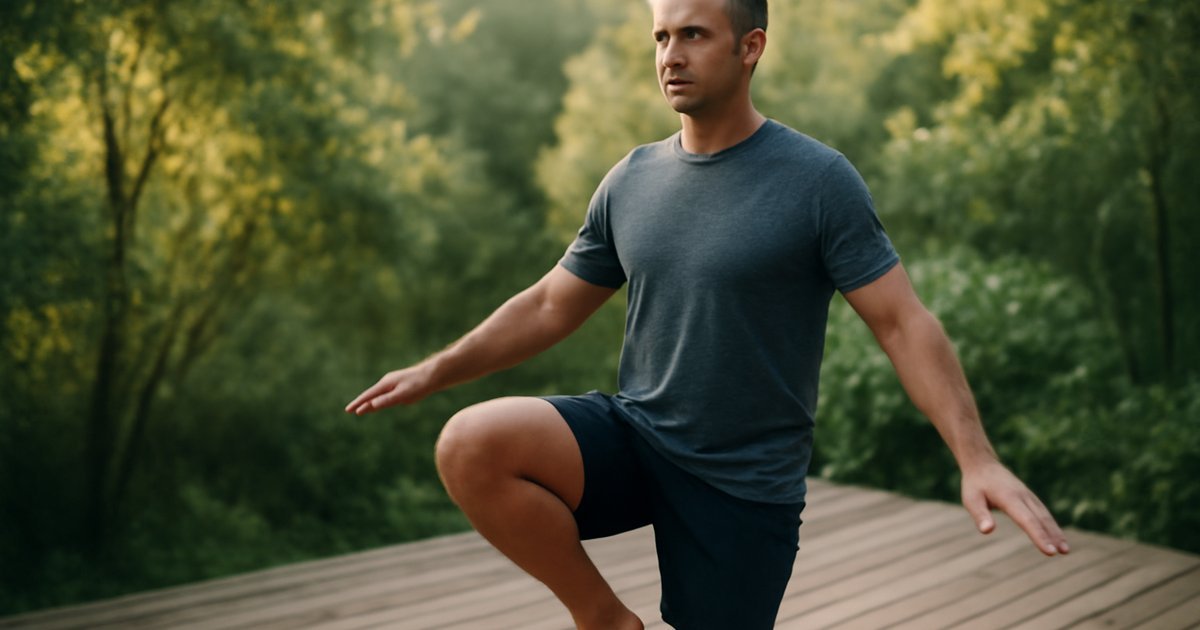
- Single-leg stance: Stand near a wall or countertop for safety. Lift one foot slightly off the ground and hold for 10–20 seconds. Switch sides. Perform 3 sets per leg. Focus on a fixed point in front of you (gaze anchoring).
- Heel-to-toe walk (tandem walk): Walk in a straight line placing one foot directly in front of the other, heel touching toes. Perform for 20–30 steps, 2–3 times. This challenges your dynamic balance in a controlled way.
- Sit-to-stand without hands: Rise from a chair without pushing off with your hands, 10 repetitions. Deceptively effective for lower-body stability and hip control.
Intermediate (Weeks 4–8)
- Single-leg stance with eyes closed: Same as above, but closing your eyes removes visual input and forces your proprioceptive and vestibular systems to work harder. Hold 10–15 seconds per side.
- Single-leg Romanian deadlift (bodyweight): Hinge forward at the hip while lifting the opposite leg behind you. Reach forward with both arms for counterbalance. 3 sets of 8–10 reps per leg.
- Lateral band walks: If you have a resistance band, loop it around your ankles and side-step 15–20 steps each direction. Activates the hip abductors, critical for lateral stability. Don't have a band? Resistance Band Training: Build Strength Anywhere has a complete starter guide.
Advanced (Week 9+)
- BOSU ball single-leg squats: Stand on the flat side of a BOSU ball and perform a single-leg squat. High proprioceptive demand. Start with 5–6 reps per leg.
- Balance board deadlifts or presses: Combine unstable surface training with loaded movements for elite neuromuscular challenge.
- Reactive balance drills: Have a partner gently tap or push your shoulder while you hold a single-leg stance. Forces your stabilizers to react in real time — the closest simulation to a real-world balance challenge.
The American College of Sports Medicine recommends that adults include neuromotor exercises — including balance and proprioception work — at least two to three days per week, integrated into a broader fitness routine.
Common Mistakes That Sabotage Your Progress
Balance training looks simple. And because of that, people often approach it carelessly — and then wonder why they're not improving.
Mistake 1: Always training with your eyes open.
Visual input is your strongest balance crutch. Most people can hold a single-leg stance for 30 seconds with eyes open, then topple immediately when they close them. If you never train without vision, you're leaving your vestibular and proprioceptive systems undertrained. Progressively reduce visual input as you improve.
Mistake 2: Holding your breath during stability challenges.
Breath-holding creates unnecessary tension in your core and reduces the neuromuscular feedback you need to make micro-adjustments. Breathe normally throughout every balance drill. This also makes the exercise harder and more effective — in a good way.
Mistake 3: Training only in isolation, not in movement.
Standing on one leg is a great foundation, but real-world balance challenges happen while you're moving — stepping off a curb, reaching overhead, pivoting quickly. After your first few weeks, integrate balance challenges into dynamic movements. Single-leg presses, step-up variations, and rotational reaches are all excellent bridges between static and dynamic balance.
Mistake 4: Ignoring ankle mobility and hip strength.
Balance doesn't start from the core — it starts from the ground up. Tight ankles and weak hip abductors are two of the most common and overlooked contributors to poor balance. If you're struggling with single-leg stability, check your ankle dorsiflexion and lateral hip strength before adding more complexity. Flexibility Training for Adults: Move Better, Feel Stronger covers ankle and hip mobility in detail.
What to Eat to Support Neuromuscular Health
Balance training is a neuromuscular endeavor — and your nervous system, muscles, and joints all need specific nutrients to function and recover optimally.
Protein: The Academy of Nutrition and Dietetics recommends 1.2 to 2.0 grams of protein per kilogram of body weight for active adults. Stabilizing muscles need protein to adapt and recover — don't undercut them. Prioritize lean poultry, eggs, Greek yogurt, legumes, and fish.
Magnesium: Essential for nerve conduction and muscle relaxation. Chronic magnesium insufficiency — common in the US — can impair neuromuscular coordination. Good sources include dark leafy greens, pumpkin seeds, almonds, and black beans. The NIH recommends 310–420 mg daily for adults, depending on age and sex.
Vitamin D: Harvard Health Publishing notes that vitamin D plays a role in muscle function and neuromuscular control. Adults with low vitamin D levels show measurably worse postural stability. The USDA recommends 600–800 IU per day from food and supplementation if needed — fatty fish, fortified dairy, and egg yolks are good food sources.
Omega-3 fatty acids: Anti-inflammatory and neurologically supportive. Research suggests omega-3s may help maintain neuromuscular function during aging. Two to three servings of fatty fish per week (salmon, sardines, mackerel) or a quality supplement can help meet needs.
Hydration: Even mild dehydration reduces proprioceptive sensitivity and reaction time. Adults should aim for roughly 2.7–3.7 liters of total water daily (including food sources), per NIH guidelines. If you're training outdoors or sweating heavily, adjust upward.
How Long Until You See Results — and What to Track
Balance improvements happen faster than most people expect — if they train consistently. Neuromuscular adaptations tend to occur before strength adaptations, which is why you often feel more stable within the first two to four weeks before you notice any visible physical changes.
Here's a realistic progression timeline:
- Weeks 1–2: Initial awkwardness gives way to improved body awareness. You may notice you're wobbling less on each attempt by the second week.
- Weeks 3–6: Static balance (single-leg holds) improves noticeably. You'll likely progress from 10 seconds to 25–30+ seconds on one leg.
- Weeks 7–12: Dynamic balance — during movement — begins to improve. You'll feel more coordinated during activities like hiking, sports, and stair navigation.
- 3–6 months: Measurable improvements in postural control, reduced lower-body injury risk, and greater confidence in daily movement. Results vary based on starting fitness level, training frequency, and any underlying musculoskeletal factors.
What to track:
- Single-leg stance time (eyes open, then eyes closed) — log weekly
- Number of wobbles or corrections per set (aim for fewer over time)
- How stable you feel during dynamic activities (hiking, sports, reaching)
- Any reduction in minor trips or stumbles in daily life
If you've been training consistently for 8 weeks and see no improvement — or if you experience pain during any balance exercise — consult a physical therapist. Persistent balance difficulty can sometimes signal inner ear disorders, neurological changes, or orthopedic issues that benefit from professional assessment.
For those looking to complement balance work with integrated strength movements, Bodyweight Training: Build Strength With No Equipment is an excellent companion resource.
Frequently Asked Questions
How often should I do balance training each week?
The American College of Sports Medicine recommends neuromotor training — which includes balance work — two to three days per week for most adults. You don't need a dedicated session; 10–15 minutes added to your existing workout or even daily standalone drills is enough to drive meaningful improvement.
Is balance training safe if I have bad knees or ankles?
In most cases, yes — but your entry point matters. If you have a current injury or chronic joint pain, start with supported exercises (near a wall or chair) and consult a physical therapist before progressing to unstable surfaces or single-leg loaded movements. Balance training is often used in physical rehabilitation precisely because it can be scaled down for any limitation.
Can yoga replace dedicated balance training?
Yoga contributes meaningfully to balance — particularly postures like tree pose, warrior III, and half-moon. However, yoga typically trains balance in slow, controlled, symmetrical environments. Dedicated balance training adds elements like eyes-closed practice, reactive drills, and single-leg loaded movements that yoga doesn't fully replicate. They complement each other well.
At what age should I start balance training?
Now, regardless of your age. Proprioceptive decline begins subtly in the 30s and becomes more noticeable in the 40s and 50s. Starting earlier means building a stronger baseline before decline accelerates. That said, significant improvements are well-documented in adults in their 60s and 70s who begin training for the first time.
Do I need special equipment to start?
Absolutely not. The most effective beginner balance exercises — single-leg stands, tandem walking, eyes-closed holds — require zero equipment. As you advance, a BOSU ball, balance board, or resistance band (for lateral stability work) can add variety and challenge, but they're optional, not required.
Start Today: One Small Step That Changes Everything
Balance training is one of the most underrated and highest-return investments you can make in your long-term physical health. It doesn't take much time, doesn't require a gym, and pays dividends that compound decade after decade — in reduced injury risk, better athletic performance, and the kind of confident, capable movement that keeps you living life fully.
You don't need a perfect plan. You need a first step. Tonight, while you're brushing your teeth, try standing on one foot for 30 seconds per side. That's it. From there, you build. Small, consistent, boring — and genuinely transformative.
Your balance is trainable. Your stability is improvable. And the best time to start is before you need to.
Wellness Disclaimer: This article is for informational and educational purposes only. The content is not intended to replace professional medical, nutritional, or fitness advice. Always consult a qualified healthcare provider, registered dietitian, or certified fitness professional before starting a new health program or making significant changes to your lifestyle.
Content reviewed by our wellness editorial team, with references to peer-reviewed research and guidelines from leading health organizations.