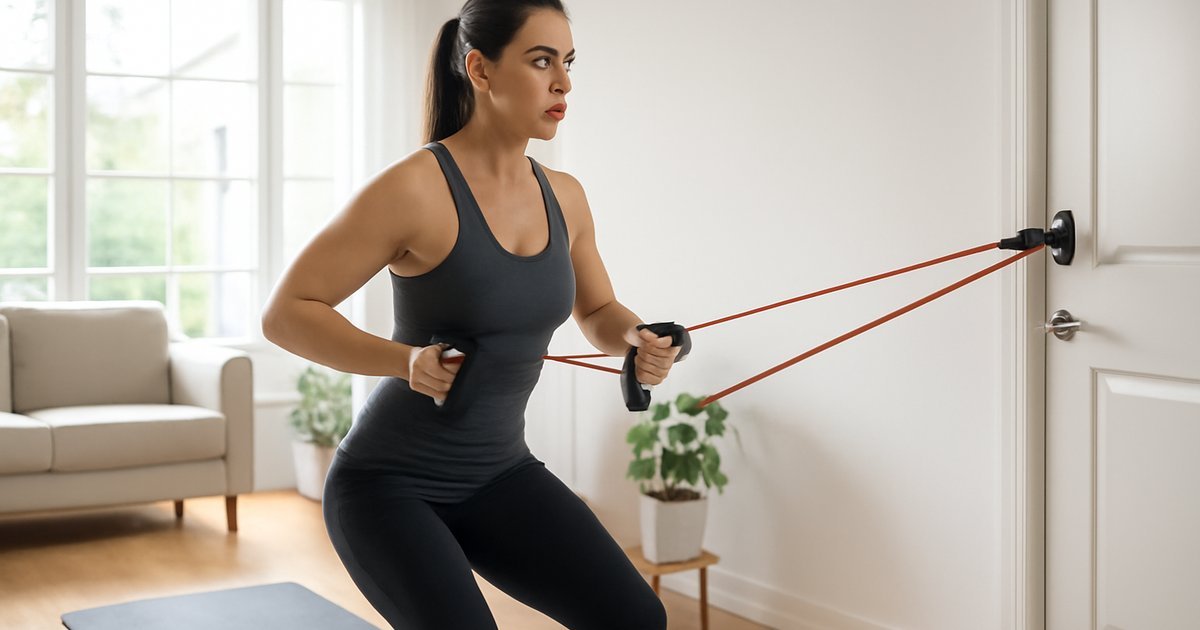
You don’t need a gym membership, expensive equipment, or hours of free time to build real, lasting strength — and resistance bands might be the most underestimated tool in modern fitness.
Why Resistance Band Training Matters More Than You Think
Most people assume that serious strength training requires barbells, dumbbells, and a gym locker. But here’s the thing: a set of resistance bands that fits in your gym bag can deliver a workout that challenges your muscles just as effectively — and in some cases, even more safely — than traditional free weights.
According to the American College of Sports Medicine (ACSM), resistance training is one of the most important forms of exercise for adults, associated with improved muscle mass, metabolic health, bone density, and functional independence as we age. The problem? Millions of adults skip it entirely because access feels complicated.
That’s where resistance bands change the game. Research published in the Journal of Human Kinetics found that elastic resistance training produces muscle strength and mass gains comparable to those achieved with conventional weight training. Same results, lower barrier to entry.
Whether you’re a complete beginner or someone returning to fitness after a break, resistance band training offers a practical, joint-friendly, and genuinely effective path to building strength — on your schedule, in your living room, hotel room, or backyard.
The Science Behind Resistance Bands: How They Actually Work
Understanding why resistance bands work so well starts with a concept called variable resistance. Unlike dumbbells or barbells — which provide a constant load throughout a movement — resistance bands increase tension as they stretch. This means your muscles face the greatest challenge at the peak of contraction, exactly where they’re strongest and most capable of handling load.
This progressive tension mirrors the natural strength curve of your muscles, which is one reason bands feel different (and sometimes harder) than free weights at equivalent resistance levels.
A 2019 meta-analysis published in the SAGE Open Medicine journal reviewed 23 studies and concluded that elastic resistance training is equally effective as conventional resistance training for improving strength in both younger and older adults. For older populations especially, the lower compressive joint forces make bands a particularly smart option.
The common myth to bust here: “Bands are only for warm-ups or physical therapy.” In reality, when used with proper tension and progressive loading, resistance bands can challenge even experienced athletes. Powerlifters and elite coaches have been using them for decades to build explosive strength and overcome sticking points.
Bands also engage your stabilizer muscles more actively than machines — because there’s no fixed path of motion, your body has to work harder to control the movement. That translates into better real-world functional strength. For a deeper understanding of how progressive challenge drives results, check out our guide on Progressive Overload: The Key to Never-Ending Fitness Gains.
How to Get Started with Resistance Band Training
Getting started is simpler than most people expect. Here’s a clear, step-by-step path organized by experience level.
Step 1: Choose the Right Bands
Resistance bands come in several formats — loop bands, tube bands with handles, and therapy bands (flat sheets). For a full-body training program, a set of tube bands with handles (light, medium, and heavy) or a set of loop bands in varying resistances gives you the most versatility.
As a beginner, start lighter than you think you need. You can always add resistance — building proper form first protects you from injury and sets you up for long-term progress.
Step 2: Master These Foundational Movements
Start with these six exercises that cover your entire body:
- Banded Squat — step on the band, hold handles at shoulder height, squat to parallel (lower body)
- Banded Deadlift — hinge at the hips with band under feet for posterior chain strength
- Banded Chest Press — anchor band behind you, press forward at chest height (chest and triceps)
- Banded Row — anchor at a low point, row toward your torso for upper back and biceps
- Banded Overhead Press — step on band, press overhead for shoulders
- Pallof Press — anchor at chest height, press straight out to challenge core stability
Beginner routine: 2-3 sets of 12-15 reps per exercise, 3 days per week with at least one rest day between sessions.
Intermediate option: Increase band tension, slow down the eccentric (lowering) phase to 3-4 seconds, or add supersets for efficiency.
Advanced option: Combine bands with bodyweight movements (banded push-ups, banded pull-ups), add unilateral exercises (single-leg deadlifts, single-arm rows), and implement periodization — varying volume and intensity week over week. For a structured approach to long-term programming, our article on Build Your Sustainable Workout Routine: A Lifelong Guide walks you through exactly how to do that.
Common Mistakes That Sabotage Your Results
Resistance band training looks simple — and in many ways it is. But a few common errors can quietly stall your progress or increase injury risk.
Mistake #1: Using too little resistance.
This is the most frequent issue, especially for people who underestimate bands compared to traditional weights. If you can complete 15 reps without any real challenge in the last 3-4 repetitions, the band is too light. Progressive overload applies to bands just as it does to barbells — you need to consistently challenge the muscle for it to adapt and grow stronger.
Mistake #2: Letting the band snap back uncontrolled.
The eccentric phase — the return to the starting position — is where a significant portion of muscle growth is stimulated. Letting the band pull you back quickly means you’re skipping half the work. Control the return movement deliberately. This is where gains are often made, not lost.
Mistake #3: Anchoring improperly.
Using a door anchor that isn’t secure, wrapping a band around a sharp edge, or anchoring at the wrong height for the exercise can compromise both safety and movement mechanics. Always check that your anchor point is stable before loading the band with full force. Door anchors should be placed on the hinge side and tested before each set.
Mistake #4: Ignoring full range of motion.
Because bands feel lighter at the start of a movement, people often rush through the beginning and only work the end range where tension peaks. Moving through the full range — from full extension to full contraction — ensures the whole muscle is being trained and supports flexibility alongside strength.
Mistake #5: Never replacing worn bands.
Resistance bands degrade over time, especially with regular use. A band that’s fraying, discolored, or losing elasticity should be retired. Snapped bands during a workout can cause real injury. Inspect bands before each session and replace them every 6-12 months depending on use frequency.
What to Pair with Resistance Band Training for Best Results
Bands are incredibly effective on their own, but pairing them with the right nutrition and complementary movement habits amplifies what they can do.
Protein intake: According to the Academy of Nutrition and Dietetics, adults engaged in regular resistance training benefit from consuming 1.2 to 1.7 grams of protein per kilogram of body weight per day. This supports muscle repair and growth following training sessions. Practical sources include eggs, Greek yogurt, lean poultry, legumes, and cottage cheese.
Hydration: Even mild dehydration (as little as 1-2% of body weight in fluid loss) has been shown in research from the American College of Sports Medicine to impair muscular endurance and strength output. Aim for at least half your body weight in ounces of water daily — more if you’re training in heat.
Recovery and mobility: Strength training without adequate recovery is counterproductive. The USDA Physical Activity Guidelines recommend that adults include at least two days of muscle-strengthening activity per week — but recovery days between those sessions are just as important. Light walking, stretching, and sleep are the underrated pillars of any resistance training plan.
Pairing your resistance training with a solid mobility practice can also help you move better during exercises and reduce injury risk over time. Our Complete Guide to Mobility Training is a great complement to any band-based strength routine.
How Long Until You See Results — and What to Track
One of the most common questions: "How long before I actually feel a difference?"
Here’s an honest, research-grounded answer: most people notice improvements in muscular endurance and energy within 2-3 weeks of consistent training. Visible changes in muscle tone and strength typically begin to emerge between 4 and 8 weeks — depending on training frequency, intensity, nutrition, sleep quality, and your individual starting point.
Harvard Health Publishing notes that neurological adaptations (your nervous system learning to recruit muscle fibers more efficiently) are responsible for the initial strength gains in the first 4 weeks. Actual muscle hypertrophy — physical growth of muscle tissue — becomes more prominent after that initial adaptation period.
What to track for progress:
- Reps and resistance level — can you complete more reps or use a heavier band this week vs. last week?
- Energy and recovery — are workouts feeling less exhausting over time?
- Body measurements — waist, hips, arms — more reliable than scale weight for tracking body composition shifts
- Functional benchmarks — can you carry groceries, climb stairs, or play with your kids without fatigue more easily?
Results vary significantly based on age, hormonal status, training history, and consistency. If you’ve been training consistently for 8-12 weeks with proper nutrition and sleep and aren’t seeing any progress, it may be time to consult a certified personal trainer or a registered dietitian to assess what might be missing.
Frequently Asked Questions About Resistance Band Training
Can resistance bands actually build muscle, or are they only good for toning?
"Toning" is largely a fitness industry myth — what most people want is a combination of reduced body fat and increased muscle definition. Resistance bands absolutely can build muscle, provided you’re using adequate tension and applying progressive overload over time. The research is clear: elastic resistance produces similar muscle and strength gains as free weights. The key word is consistent progressive challenge.
Are resistance bands safe for people with joint pain or arthritis?
Generally, yes — and this is one of the biggest advantages of bands over heavy free weights. The lower compressive forces on joints make them a popular recommendation in physical therapy and rehabilitation. That said, if you have a diagnosed joint condition, always consult your physician or a physical therapist before beginning any new exercise program. They may recommend specific modifications.
How many days per week should I train with resistance bands?
For most adults, 3 to 4 days per week is an effective and sustainable frequency. The ACSM recommends at least two days per week of muscle-strengthening activity for general health. If you’re training full-body each session, include at least one rest or active recovery day between sessions to allow muscles to repair and grow.
Do I need to combine bands with other equipment?
Not at all. A complete, effective training program can be built entirely around resistance bands. However, if you have access to bodyweight exercises (push-ups, pull-ups, dips), combining them with bands adds useful variety and can address certain muscle groups more effectively. Bands pair especially well with compound movement patterns that train multiple muscle groups at once.
What’s the best way to progress when a band starts feeling too easy?
You have several options: move up to a higher resistance band, slow down your reps (especially the eccentric phase), decrease rest time between sets, add more sets or reps, or shift to unilateral (single-limb) variations of the same exercise. All of these apply the principle of progressive overload — the foundation of any lasting strength program.
Start Where You Are — It’s Enough
You don’t need to overhaul your entire life to start building real strength. You just need a few bands, 30 minutes three times a week, and the willingness to show up consistently.
Resistance band training isn’t a compromise — it’s a genuinely powerful training tool that has been validated by research, used by elite athletes, and recommended by rehabilitation specialists worldwide. It fits your schedule, respects your joints, and travels anywhere you do.
The best workout is always the one you’ll actually do. And the best place to start is exactly where you are right now.
Pick up a set of bands this week, run through those six foundational movements, and give yourself 30 days of consistent effort. The difference it makes might surprise you.
Wellness Disclaimer: This article is for informational and educational purposes only. The content is not intended to replace professional medical, nutritional, or fitness advice. Always consult a qualified healthcare provider, registered dietitian, or certified fitness professional before starting a new health program or making significant changes to your lifestyle.
Content reviewed by our wellness editorial team, with references to peer-reviewed research and guidelines from leading health organizations including the American College of Sports Medicine, Academy of Nutrition and Dietetics, Harvard Health Publishing, and the USDA Physical Activity Guidelines.
Leave a Reply