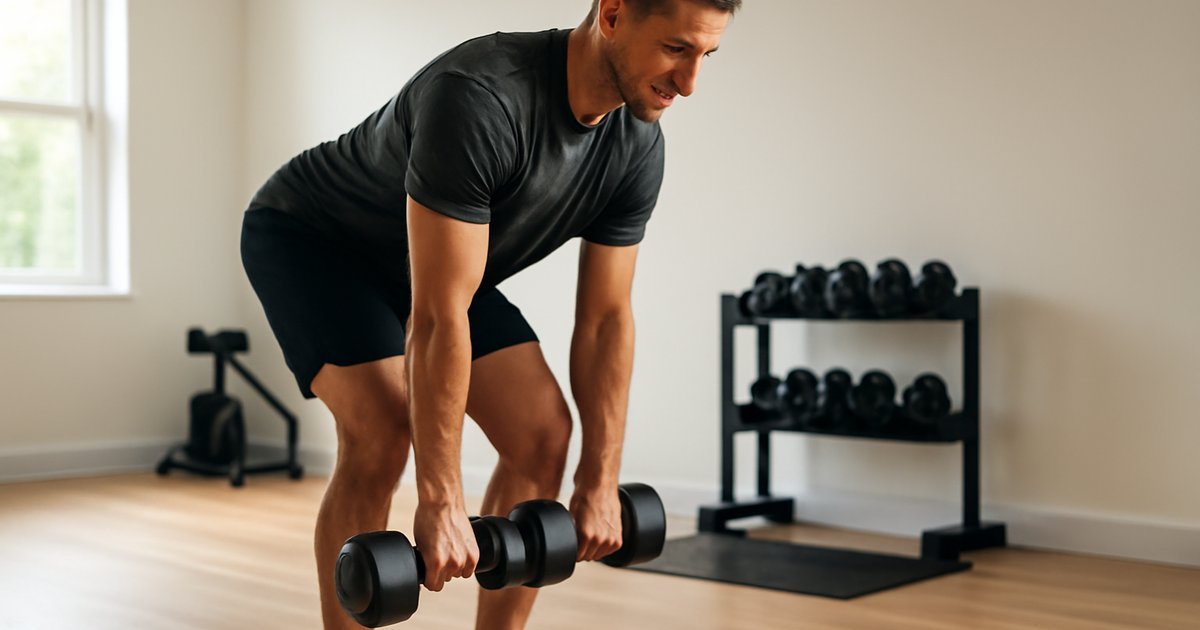
Dumbbell Training for Adults: Build Strength and Burn Fat
You don’t need a fancy gym setup or expensive machines — two dumbbells and a plan can completely change your body and energy levels.
If you’ve ever walked into a gym and felt overwhelmed by all the equipment, you’re not alone. Rows of machines, cable setups, and complicated racks can make the idea of strength training feel inaccessible. But here’s what most people don’t realize: dumbbells are one of the most versatile, science-supported tools in all of fitness — and they work just as well at home as they do in a gym.
Dumbbell training for adults is having a well-deserved moment, and the research backs it up. Whether your goal is to build lean muscle, improve your metabolic health, reduce joint pain, or simply feel stronger moving through daily life, a well-designed dumbbell workout program can deliver meaningful, lasting results.
In this guide, you’ll learn exactly how dumbbell training works, why it’s especially effective for adults over 25, how to get started safely, and what common mistakes to avoid. No fluff — just practical, evidence-backed guidance you can apply starting today.
Why Dumbbell Training Matters More Than You Think
Here’s a stat that puts things in perspective: according to the American College of Sports Medicine (ACSM), adults begin losing 3 to 5 percent of muscle mass per decade after age 30 — a process called sarcopenia. By age 60, some individuals have lost as much as 30 percent of their total muscle mass if they haven’t been actively training.
That’s not just a cosmetic issue. Muscle loss is directly tied to reduced metabolism, increased risk of type 2 diabetes, poor bone density, and a higher likelihood of injury from everyday activities. Resistance training — including dumbbell work — is one of the most effective interventions known to slow this decline.
What makes dumbbells particularly valuable is the way they engage your stabilizer muscles. Unlike fixed machines, which lock your body into a guided path, dumbbells require your joints, tendons, and smaller muscle groups to work together to control the movement. This means you’re building functional strength — the kind that translates to carrying groceries, playing with kids, or staying injury-free on the trail.
Research published in the Journal of Strength and Conditioning Research found that free-weight training produced significantly greater activation of stabilizer muscles compared to machine-based training, without sacrificing overall strength gains. That’s a compelling reason to grab a pair of dumbbells and get to work.
How Dumbbell Training Actually Works
Let’s clear up a common myth first: lifting weights won’t make you bulky unless you’re eating a significant caloric surplus and training specifically for hypertrophy over many months. For most adults, consistent dumbbell training leads to a leaner, more defined physique — not an oversized one.
Here’s what’s actually happening inside your body when you train with dumbbells. When you create mechanical tension by lifting a load — say, performing a dumbbell row — you create microscopic damage to your muscle fibers. Your body responds by repairing those fibers stronger than before, a process driven by satellite cells and protein synthesis. Over time, this leads to increased muscle density, improved neuromuscular coordination, and a higher resting metabolic rate.
According to Harvard Health Publishing, adding just 10 pounds of lean muscle can increase your resting metabolism by approximately 100 calories per day. That may not sound like much, but over weeks and months, it adds up considerably.
Dumbbell training also supports cardiovascular health when structured correctly. Circuit-style dumbbell workouts — where you move from one exercise to the next with minimal rest — can keep your heart rate elevated and deliver metabolic conditioning benefits similar to moderate-intensity cardio. This dual-purpose efficiency is one reason busy adults often prefer it over isolated cardio sessions.
One thing to keep in mind: results vary significantly based on your starting point, training frequency, recovery quality, and nutrition. Dumbbell training is a powerful tool, but it works best as part of a broader wellness approach.
How to Get Started: A Practical Step-by-Step Plan
Getting started with dumbbell training doesn’t require perfection — it requires consistency and a sensible structure. Here’s how to build a foundation that sticks.
Step 1 — Choose your starting weights wisely.
For most beginners, a range of two to three dumbbell pairs works well: a lighter set (8–12 lbs), a moderate set (15–20 lbs), and a heavier set (25–35 lbs). Adjustable dumbbells are a space-efficient and cost-effective option if you’re training at home. The right weight for any given exercise is one where the last 2–3 reps feel challenging but your form remains solid.
Step 2 — Start with a 3-day-per-week full-body program.
Beginners benefit most from training the full body each session rather than splitting by muscle group. A simple structure might look like this: Day 1 (Monday), Day 2 (Wednesday), Day 3 (Friday), with rest or light activity on the days in between. This frequency allows adequate recovery while building the motor patterns you need to progress.
Step 3 — Master the foundational movement patterns first.
Before chasing heavy weights, focus on learning five essential movement patterns:
- Push — Dumbbell chest press, overhead press
- Pull — Dumbbell rows, reverse fly
- Hinge — Romanian deadlift, single-leg deadlift
- Squat — Goblet squat, split squat
- Carry — Farmer’s carry, suitcase carry
A well-rounded dumbbell session includes at least one exercise from each category, hitting your upper and lower body while keeping the core engaged throughout. For a strong foundation in total-body movement, our guide on compound exercises for full-body strength pairs perfectly with this approach.
Beginner sample session (30–40 minutes):
- Goblet Squat — 3 sets x 10 reps
- Dumbbell Romanian Deadlift — 3 sets x 10 reps
- Dumbbell Chest Press — 3 sets x 10 reps
- Bent-Over Row — 3 sets x 10 reps per arm
- Farmer’s Carry — 3 sets x 30 seconds
Intermediate upgrade: Add supersets (pairing a push with a pull), increase weight by 5% when you can complete all reps with clean form, and incorporate unilateral movements (single-arm, single-leg) to address muscle imbalances. For those ready to challenge their endurance alongside strength, the principles in Zone 2 cardio training can complement your dumbbell sessions effectively.
Common Mistakes That Sabotage Your Dumbbell Training Results
Even motivated adults make these missteps — and they can stall progress faster than you’d expect.
Mistake #1 — Using weight that’s too light for too long.
This is by far the most common issue, especially among women who are concerned about getting bulky. If your last rep of a set feels effortless, the weight isn’t creating enough stimulus to trigger adaptation. The fix: apply progressive overload — gradually increase your resistance, reps, or sets over time. Our detailed guide on progressive overload training walks you through how to do this systematically without risking injury.
Mistake #2 — Skipping the warm-up.
Jumping straight into heavy sets with cold muscles and stiff joints dramatically raises your injury risk. A 5–8 minute dynamic warm-up — think leg swings, arm circles, hip hinges, and bodyweight squats — prepares your nervous system and increases range of motion. This matters even more as you get into your 30s, 40s, and beyond.
Mistake #3 — Neglecting the posterior chain.
Most people instinctively train what they can see in the mirror — chest, biceps, quads. But your posterior chain (glutes, hamstrings, upper back, rear delts) is just as important for posture, injury prevention, and total-body strength. Make sure every training week includes Romanian deadlifts, rows, and reverse flies.
Mistake #4 — Training without adequate rest between sessions.
Muscle isn’t built in the gym — it’s built during recovery. According to the ACSM, most adults need 48 to 72 hours of recovery between sessions targeting the same muscle groups. Training the same muscles daily without rest can lead to overtraining, elevated cortisol, and regression rather than progress.
Mistake #5 — Inconsistent breathing.
Holding your breath during lifts (especially heavier ones) spikes internal pressure and reduces stability. The general rule: exhale on the exertion phase (when you lift or press), inhale on the return. Practicing this deliberately makes it automatic over time.
What to Eat to Support Dumbbell Training Results
Training without adequate nutrition is like building a house without materials. Your muscles need specific fuel to repair, grow, and perform.
Protein is your top priority. The Academy of Nutrition and Dietetics recommends that adults engaged in regular resistance training consume 1.2 to 1.7 grams of protein per kilogram of body weight per day. For a 160-pound adult, that’s roughly 87 to 123 grams of protein daily. High-quality sources include lean chicken and turkey, eggs, Greek yogurt, cottage cheese, canned tuna, legumes, and tofu.
Don’t neglect carbohydrates. Carbs are your muscles’ primary energy source. Low-carb approaches may blunt performance and recovery, particularly if you’re training at moderate to high intensity. Focus on whole-food carbs: oats, brown rice, sweet potatoes, quinoa, and fruit.
Healthy fats support hormonal balance. Dietary fat plays a direct role in testosterone and estrogen regulation — hormones that affect muscle-building capacity. The USDA Dietary Guidelines recommend 20–35% of total calories from fat, prioritizing unsaturated sources like olive oil, avocados, nuts, and fatty fish.
Timing matters — a little. While total daily protein intake is the bigger lever, consuming a protein-rich meal or snack within 1–2 hours post-workout can support muscle protein synthesis. A Greek yogurt with berries, a protein shake with milk, or eggs on whole-grain toast are all solid options.
Hydration: Even mild dehydration (1–2% of body weight) can reduce strength output and cognitive performance during training. Aim for at least half your body weight in ounces of water daily, and more on training days.
How Long Until You See Results — and What to Track
Honest answer: noticeable physical changes typically take 6 to 12 weeks of consistent training and adequate nutrition. But that doesn’t mean nothing is happening before that.
In the first 2–4 weeks, the primary adaptations are neurological. Your brain is learning to recruit muscle fibers more efficiently, which is why many beginners feel stronger before they look different. Strength gains during this phase can be significant — sometimes 10 to 20 percent increases in working weight — even without visible muscle growth.
Visible changes in muscle definition and body composition typically become apparent after 8–12 weeks when training is combined with adequate protein and a reasonable caloric intake. Research published in Sports Medicine confirms that untrained adults can expect meaningful improvements in strength, lean mass, and functional capacity within a 12-week progressive resistance program.
What to track:
- Working weights per exercise (are they going up over time?)
- Reps completed at a given weight
- Energy levels and recovery quality
- Body measurements (waist, hips, arms) — more reliable than scale weight alone
- How everyday tasks feel (climbing stairs, carrying bags, posture)
If you’ve been training consistently for 12 weeks with no perceptible improvement in any of these areas, consider reassessing your program, nutrition, sleep quality, or consulting a certified personal trainer or registered dietitian for personalized guidance.
Frequently Asked Questions About Dumbbell Training
Can I build serious muscle with just dumbbells?
Absolutely — especially in the beginner to intermediate range. Dumbbells allow for a wide range of loads, movements, and tempos that can drive significant muscle and strength gains. Advanced lifters may eventually benefit from adding barbells or other tools for maximal loading, but most adults can achieve excellent results with dumbbells alone.
How heavy should my dumbbells be?
This depends entirely on the exercise and your current fitness level. A general rule: if you can complete more than 15 reps with perfect form and feel minimal fatigue, go heavier. If you can’t complete 8 reps with proper technique, drop down. Investing in an adjustable set or two to three pairs of different weights gives you the most flexibility.
Is dumbbell training safe for people with joint issues?
For many people with mild to moderate joint concerns, dumbbell training can actually improve joint stability and reduce pain over time by strengthening the muscles that support the joint. That said, this depends on the specific condition. If you have a diagnosed joint issue — knee osteoarthritis, shoulder impingement, or similar — consult a physical therapist or sports medicine physician before starting a program.
How many days per week should I train with dumbbells?
For most adults, 3 full-body sessions per week is an excellent starting point and sustainable long-term. As you advance, you might move to a 4-day upper/lower split. More than 5 days per week of resistance training is generally unnecessary for general health and wellness goals, and recovery becomes increasingly important with age.
Do I need to stretch after dumbbell workouts?
Post-workout stretching can support flexibility and reduce muscle soreness — and it’s a good habit to build. Spend 5–10 minutes on static stretches targeting the muscles you just worked. For a deeper approach to improving mobility alongside your strength training, explore our guide on flexibility training for adults.
Start Simple, Stay Consistent, and Let the Results Follow
Dumbbell training isn’t a shortcut or a trend — it’s one of the most time-tested, research-supported methods for building strength, improving body composition, and protecting your long-term health. The barrier to entry is low, the equipment is affordable, and the benefits compound over time in ways that go far beyond aesthetics.
You don’t need to overhaul your entire life to start. Pick up a pair of dumbbells. Learn the five foundational movement patterns. Train three days a week. Eat enough protein. Sleep well. Track your progress. Then do it again next week.
Small, consistent actions are what separate people who transform their health from those who stay stuck. Today is a great day to take the first step.
This article is for informational and educational purposes only. The content is not intended to replace professional medical, nutritional, or fitness advice. Always consult a qualified healthcare provider, registered dietitian, or certified fitness professional before starting a new health program or making significant changes to your lifestyle.
Content reviewed by our wellness editorial team, with references to peer-reviewed research and guidelines from leading health organizations.
Leave a Reply